Why Paid Ads Too Early Kill Startups
Launching a startup often feels like a race against time and obscurity. It’s tempting to smash the gas pedal with paid ads on Google, Facebook, Instagram, or TikTok the moment your product is live. After all, more eyeballs mean more users, right? Unfortunately, for many fledgling companies, early paid advertising can become a fatal trap. It can inflate vanity metrics, burn precious cash, and even mask fundamental product flaws until it’s too late. As investor wisdom warn: good marketing won’t save a bad product. More on this below.

The Illusion of Early Traction
In the adrenaline rush of a new venture, a burst of users from paid ads can feel like success. Your dashboard spikes with sign-ups, downloads, or website hits – growth at last! But dig deeper and you may find a mirage. Many of those users vanish as quickly as they arrived. Paid advertising can pump up “vanity metrics” numbers that look impressive but don’t indicate genuine engagement or customer love. It’s dangerously easy to fool yourself into mistaking a paid traffic spike for real traction.
Consider that traction can be manufactured if you throw enough money at it. A startup’s growth rate can appear “impressive”, until you learn they were spending $4 in marketing for every $1 in new revenue. In an era of easy VC money, some companies did exactly that to show momentum, only to hit a wall when the funding climate changed. Users acquired at high cost tend not to stick around if the product doesn’t truly meet their needs.
“34% of failed startups had reported “impressive traction” in their pitches just months before they imploded, often by touting inflated vanity metrics that masked an unsustainable business.”
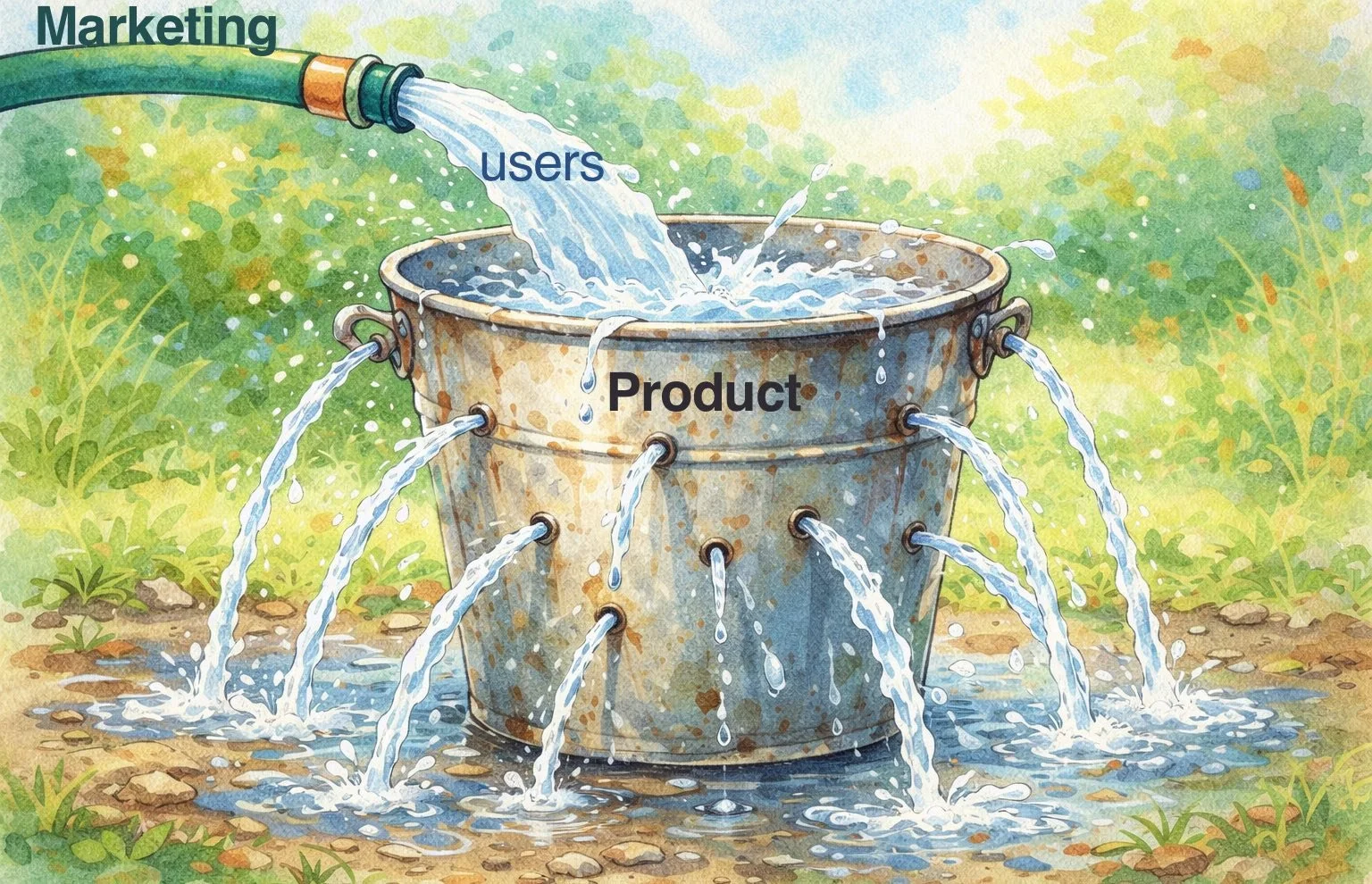
Vanity metrics create a false sense of security. A startup might brag about 100,000 downloads or a million pageviews, but if those users aren’t active, retained, and happy, the numbers are hollow. As Y Combinator insiders note, paid ads can “mask underlying product–market fit issues”, giving the illusion of growth while “terrible retention” lurks underneath. It’s like filling a leaky bucket: water pours in, but quickly leaks out the holes. The core danger is believing you’re further along than you really are, which leads founders to pour even more money on a fire that isn’t actually burning.
Product-Market Fit or Bust
Every experienced founder and investor preaches the same gospel: nail product-market fit before you scale marketing. Product-market fit (PMF) means you’ve built something people want so badly that they naturally stick around and tell others. Until you reach that point, buying users with ads is at best inefficient and at worst lethal. There’s little point to aggressively marketing a product that brings no value to its users. People may come once out of curiosity, but they’ll quickly leave. All you’re doing is momentarily filling that leaky bucket, not fixing the holes.
In startup post-mortems, the lack of product-market fit shows up again and again as the kiss of death. “No market need” is the #1 reason for failure. In other words, the product itself wasn’t compelling. One more reason startups fail is simply running out of money before achieving product–market fit. One of the main ways this happens is by dumping money into growth efforts too soon, before they’ve built a truly must-have product.
Why is advertising pre-PMF so wasteful? Here’s an analogy from physics: Marketing is a force multiplier, it will multiply what’s already there. But multiply zero by anything and you still get zero. If only 2% of your signups become active users, then pouring more users into the funnel just means more churn out the bottom. If it costs you $5 to acquire a customer who only ever provides $1 of revenue (a case of CAC > LTV), then more marketing means more losses. Early paid ads can paper over these grim unit economics for a time, but eventually reality catches up. If the underlying product is weak, ads will just accelerate your demise.
Y Combinator famously advises startups to “Do things that don’t scale” in the early days – meaning focus on hand-crafting a great product and user experience, not on mass marketing. The reasoning is simple: “In their vast experience, YC haven’t seen ads lead to PMF”. Instead, you should be spending time talking to users, iterating the product, and achieving organic pull. Only once people truly love what you’ve built does it make sense to pour gasoline (ad dollars) on the fire to make it burn hotter.
The goal in the early stage is to prove out a product that retains users and delivers real value. Retention (how many users keep coming back) is a far more vital metric than raw signup counts. If your retention curve drops to zero, you simply don’t have PMF, no matter what your Google Analytics says about web traffic.
The Burn Rate Trap
Beyond the illusion of traction, there’s a more tangible risk to early advertising: it can immolate your runway. Startups live and die by their cash reserves, and buying users is expensive. If those users don’t stick around and generate revenue, you’re essentially setting piles of money on fire – money that won’t be there later when you desperately need it to refine your product or keep the servers running. Cash is oxygen. Startups don’t fail from bad ideas, they suffocate on overspending. Dumping budget into ads without ROI is a fast route to asphyxiation.
Research bears this out. The Startup Genome Project found that 70% of startups scaled (ie, spent/hired) prematurely, and this was the #1 cause of failure. These companies showed flashy early growth: “rapid customer acquisition, revenue growth, flashy PR”, but grew slower and burned 10x faster in the long run than startups that paced themselves toward sustainable growth. In effect, they ran on a financial treadmill, always needing more investor cash to keep going, without the underpinning of a viable model. Early ad spending can put you on that treadmill, forcing you to raise bigger and bigger rounds to fund marketing that barely maintains your user base, until investors lose faith.
We’ve seen some spectacular flameouts from this phenomenon. Homejoy, a highly touted on-demand cleaning startup, raised $35M and expanded to dozens of cities, only to shut down when the cost of acquiring customers outpaced what those customers were worth. Fab.com, once a flash-sale e-commerce unicorn, spent huge sums on initial marketing campaigns that won it a burst of buyers, but didn’t create repeat purchase habits. Fab grew its sales rapidly, only to find those early customers drifting away. When growth stalled, Fab’s lavish spending became unsustainable. Quibi, the short-form video platform, is another cautionary tale: it famously spent millions on a Super Bowl ad and celebrity-driven campaigns before launch, only to find almost no one was truly interested in its product. Within six months of launch, Quibi was dead in the water, proving that no amount of hype can save a product people don’t actually want. Good marketing can make the phone ring, but your product decides if they call back.
Perhaps the darkest side of early paid acquisition is how hard it becomes to quit once you start. If your baseline growth without ads is near zero, you might feel compelled to keep spending just to show any growth at all, even if each dollar spent is unprofitable. Some venture-backed startups get hooked on this cycle: they raise a big round, pour it into ads to spike their user numbers, then use those vanity metrics to raise the next round, and repeat. It’s essentially a Ponzi scheme of user growth. But eventually, there’s no way back, only pour even more until bust. Such startups get addicted to paid acquisition. The underlying business makes no sense: it costs more to acquire a customer than the revenue they’d ever bring, but stopping the ad spend would mean flatlining. The result is inevitable collapse, just delayed. If your growth engine can only run on piles of cash, you’re heading for a crash.
Case Studies
Let’s look at a few real-world examples that illustrate the do’s and don’ts of early-stage growth:
❌ Fab.com: We touched on Fab’s fate above. Once valued at $1B as a design marketplace, Fab raised enormous capital and plowed it into advertising and expansion long before the model was proven. The initial surge of customers quickly evaporated when they realized they could find the same products cheaper elsewhere (hello, Amazon). Fab hadn’t built true loyalty or differentiation – it was skating by on novelty and ad blitz. When revenue didn’t meet expectations, the company had to slash costs and sell in a fire sale. Fab’s founder later admitted to a litany of mistakes, from premature scaling to neglecting the core user experience. The takeaway: Ads can bring in one-time buyers, but they can’t buy you a loyal community.
❌ Quibi: Quibi’s demise in 2020 has become startup legend. Backed by nearly $2B and led by Hollywood execs, Quibi spent extravagantly on marketing (from high-profile endorsements to a Super Bowl spot) to launch a mobile streaming service. The problem was, consumers never asked for what Quibi was selling: quick bites of exclusive content on your phone, and the execution was clunky. Quibi essentially tried to brute-force product-market fit via marketing, an effort doomed from the start. The faster Quibi signed up curious trial users, the faster word spread that the app wasn’t worth keeping. Within six months, Quibi shut down, proving that even limitless marketing spend can’t compensate for poor product-market fit.
👍 Buffer: In contrast, consider Buffer, the social media scheduling tool. In its early days, Buffer had zero budget for ads. Instead, the founders focused on content marketing and community-building. They wrote helpful blog posts about social media strategies and engaged with users on Hacker News and Twitter. This organic approach struck a chord; people found value in the content and discovered Buffer as a solution to their problems. Thanks to this strategy, Buffer amassed 70k users in its first year without spending a dollar on ads. Those users came through word-of-mouth and trust, meaning they were inherently more interested and sticky than random ad-clickers. Buffer delayed any significant paid advertising until it had a loyal user base and a clear sense of who its customers were. Even today, Buffer is known for its transparent, user-centric culture, a far cry from flash-in-the-pan startups that chased vanity metrics.
👍 Canva and Spanx: Canva, the online design platform, and Spanx, the famed shapewear brand, might operate in different arenas (software vs. apparel), but they share a common growth story. Neither spent on big ads early on, they focused on product quality and organic buzz. Canva’s founders concentrated on making the design process ridiculously easy and accessible; users loved it and invited teammates and friends. Canva had minimal early marketing, yet it snowballed to over 135M users on the strength of the product itself. Spanx founder Sara Blakely started selling her first product out of her apartment and couldn’t afford ads even if she wanted them. So she hustled via word-of-mouth, personally convincing department store buyers and customers one by one. Women who tried Spanx were delighted and told their friends, setting off a chain reaction. Years later, Spanx still hardly advertises – it doesn’t need to. Blakely’s advice: “Know your product.” If you build a great product, it will market itself through customers’ recommendations. Indeed, a Nielsen study shows 77% of people are likely to buy a product recommended by a friend – far more convincing than any ad. The lesson from Canva and Spanx: by perfecting your offering and creating true fans, you earn the right to scale up marketing when the time is right.
👍 Airbnb: One more classic example: in 2009, Airbnb was close to flatlining with only $200/week in revenue. Instead of dumping their meager funds into ads, the founders flew to New York and literally knocked on doors, meeting users and taking high-quality photos of listed apartments to improve the experience. This famously unscalable tactic doubled their weekly revenue and set them on a path to product-market fit. Airbnb proved that understanding your market and removing friction (in their case, bad listing photos) is far more important in the early days than any ad campaign. Once they had momentum and happy users, Airbnb later turned on paid marketing. But by then, the product’s value was clear and each marketing dollar was exponentially more effective.
These stories underscore a pattern: startups that thrived did so by getting the product and organic growth right first, then scaling up marketing. Those that failed often did the opposite: trying to buy growth before earning it. To quote marketing veteran Emil Kristensen: “Sure, you’ll need marketing. But marketing amplifies what’s already there. As a founder, your focus should be crystal clear: Product. Product. Product.” In other words, if you haven’t built something people want, all the ads in the world won’t save you. And if you have built something people want, you might not need a big ad spend to reach them, they’ll find you via word-of-mouth.
Innovation Adoption Curve
Let me tell you a quick story. When I was younger, I worked at a startup as a software engineer. Our CEO came from traditional brick-and-mortar business, where launching something usually means going big on marketing. So on launch day he did exactly that, bought ads everywhere: billboards across the city, banners in shopping malls, street advertising. It was a big, expensive campaign. For him it seemed logical: more ads → more people → more customers. Now guess what happened. Was the startup successful? Unfortunately, no.
The Innovation Adoption Curve is a model that illustrates how an innovation is adopted by a population. Every new product spreads through the market in stages:
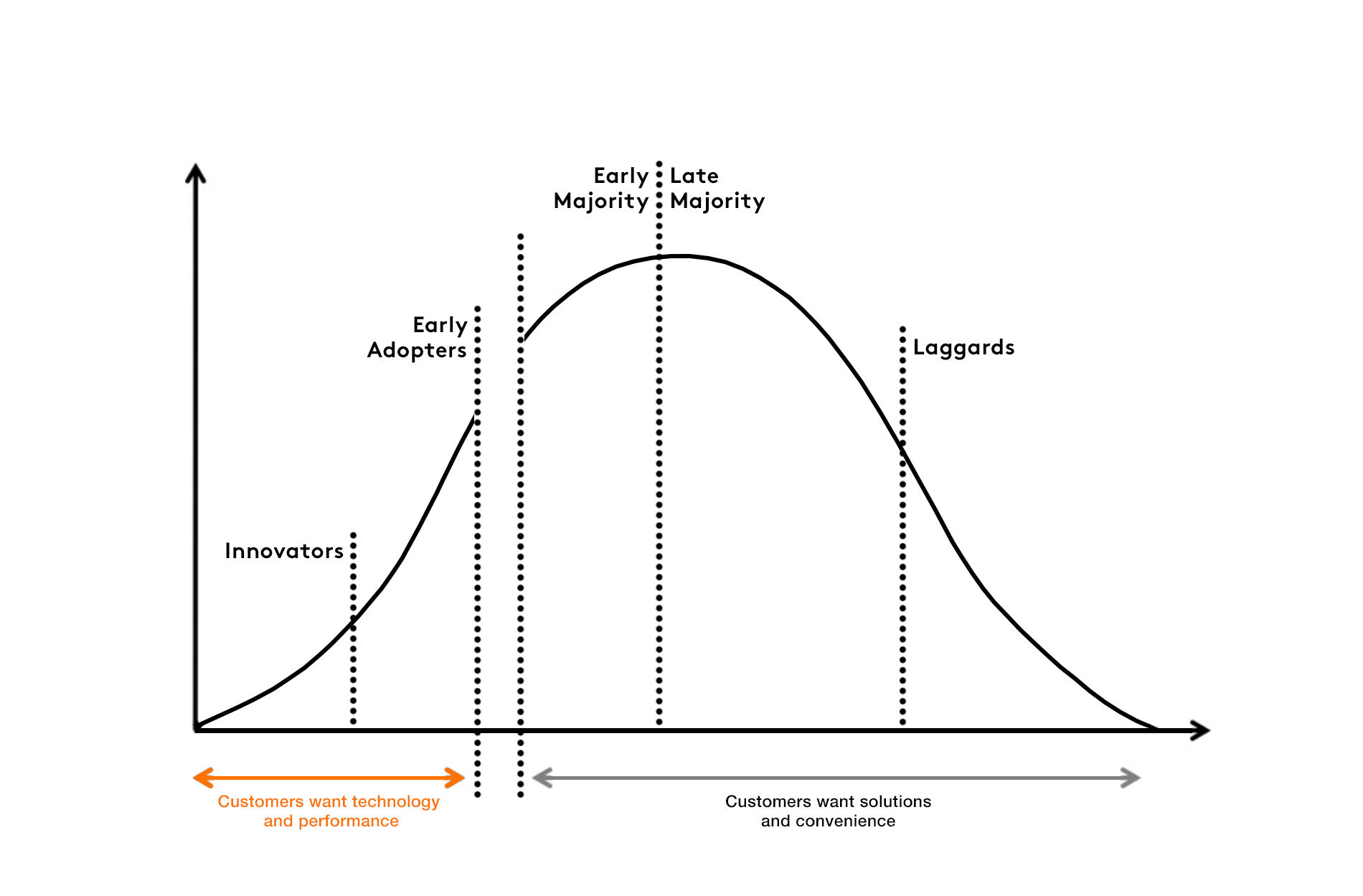
First come the Innovators - the weird tech nerds who love trying unfinished stuff. Then the Early adopters - people who see potential before everyone else. These two groups are your gold mine as a startup. They tolerate bugs. They forgive rough UX. And most importantly, they give feedback. They’ll tell you: “This feature is confusing”, “This is the real problem you should solve”, “You’re building the wrong thing.” That feedback is what helps a startup find product-market fit.
The people who see ads in malls and on billboards are not early adopters, they are the mass market. And the mass market expects a polished, finished product: something convenient, smooth, and reliable. But early startups are messy. Features change, UX is rough, things break. So people came in, tried the product once, and disappeared. No patience, no useful feedback, just wasted marketing budget. The irony is that the people who actually tolerate early products, innovators and early adopters, almost never discover startups from billboards or mall ads.
The people you actually need, innovators, almost never come from ads.They come from: niche communities, Reddit, Hacker News, Discord groups, Twitter tech circles, forums. Places where people like discovering new things early. That’s where startups should hunt in the beginning. Not the Facebook ads manager.
Smarter Ways to Gain Early Traction
If not paid ads, then how should a resource-constrained startup get that critical early traction? The good news is there are plenty of scrappy, cost-effective ways to build a user base and validate your market. They may not be as fast or easy as clicking “Go” on a Facebook Ads campaign, but they’re far more likely to set you up for long-term success. Here are some strategies, backed by founder experiences and investor advice:
Do Things That Don’t Scale. This phrase coined by Paul Graham has become startup lore for a reason. It means hustle manually to get your first users. Personally email or call potential users, go to where your target customers hang out (online forums, local meetups), give live demos, offer concierge onboarding, whatever it takes. Sure, it’s inefficient, but you’ll learn tremendously from each interaction. Early on, you should be as close to your end user as possible. Those personal touches not only win you loyal early adopters, they give you unfiltered feedback to improve your product. Stripe famously got its first users by literally installing the product for them in person. Airbnb’s door-to-door campaign in NYC is the same example. This hands-on approach is the polar opposite of blasting out ads and hoping something sticks. It’s targeted, meaningful, and it builds a foundation of true believers.
Focus on Retention and Referrals. Instead of obsessing over how to get more users right away, focus on delighting the few you have. Make your product so good that those users keep coming back and invite others. High retention is the strongest sign of product-market fit, and referrals mean you’ve hit on something shareable. Design your onboarding to deliver value quickly; talk to users to understand what they love or where they struggle. Some startups even hold off on growth until they see, say, 30% of users converting to paid or a cohort retention curve flattening above zero, proof that users are sticking around. When you hit those markers, your satisfied users become a free marketing force, spreading the word on their own. Early adopters often take pride in telling friends about a cool new product, it makes them look savvy. Tap into that! For example, PayPal and Dropbox’s early growth surged through referral incentives, not ads. They gave bonuses for inviting friends, leveraging happy customers to do marketing. This kind of organic growth is slower at first but immensely powerful; it indicates you’re building on solid ground, not just buying attention.
Content Marketing and Thought Leadership. Becoming a valuable source of information in your niche can attract users organically. Buffer’s 70k user success via blogging is a prime case. Identify topics that your target customers care about and produce genuinely helpful content: blog posts, how-to guides, videos, podcasts. Content marketing costs mainly time and creativity, not heaps of cash, and it has compounding returns. Great content builds your brand’s credibility and brings in readers who can convert to users. Devoted readers also share articles with others = more organic reach. The key is consistency and quality. No one wants to read AI slop or a thinly veiled ad for your product. Focus on education or entertainment value. For instance, Trello gained early traction by publishing articles about productivity and team collaboration, attracting exactly the audience likely to use a tool like Trello.
Community Building. Instead of paying to access someone else’s audience, build your own. This could mean a Slack group, Discord server, subreddit, or forum for people interested in the problem you’re solving. Cultivate a community around your mission or domain. Not only does this create loyal followers, but you get direct insight into your users’ needs. For example, Glossier (now a major beauty brand) started as a community blog where women talked about makeup and skincare. By the time Glossier launched products, they had a built-in fan base and tons of user insight, achieved with minimal marketing spend. Being authentic and engaging regularly with a community can create champions for your brand who bring others along.
Guerrilla and Viral Tactics. Get creative and a bit scrappy. Early-stage startups have done things like posting and answering questions on Quora or Reddit (establishing expertise), listing on Product Hunt for a launch boost, offering a limited-time freebie or contest that gets people sharing, or even pulling off PR stunts that earn media coverage for free. Think about how to get people talking without big ad dollars. When Mailbox launched, they created an innovative mobile waitlist that users could watch in real time. It generated buzz and FOMO, attracting tons of signups organically. The goal is to leverage ingenuity over cash. This kind of hustle not only saves money, it often feels more genuine to users than ads.
Small-Scale Paid Experiments. If you do decide to dip a toe into paid advertising, treat it as a measured experiment, not a growth lifeline. For example, you might spend a few hundred dollars on highly targeted Facebook ads to test which messaging resonates, or run a tiny AdWords campaign to see if there’s search interest for your solution. The point is to gather data, not to “buy growth”. Keep the budgets limited and the goals focused (e.g., learn which ad copy yields a higher click-through from your exact target demographic). Very few people actually know how to set up a decent campaign. Without that knowledge, you’re likely to waste money. Save paid marketing for when you have positive signals to amplify. In the meantime, any minor ad tests should be treated as learning exercises, and you should be prepared to turn them off quickly if they don’t perform.
Remember, the goal of early traction efforts is to validate that you have a product people truly want and to get the kinds of users who will stick around. These scrappy strategies may not produce the vanity numbers of a big ad campaign, but they produce understanding, loyalty, and word-of-mouth momentum – the real ingredients of sustainable growth. By the time you eventually invest heavily in advertising, you’ll have a far clearer idea of who your audience is, what messaging works, and how to turn paid leads into long-term customers.
Earn the Right to Scale
For startup founders eager to break out, the siren song of quick growth via paid ads is hard to resist. It promises scale, visibility, and traction in a hurry. But as we’ve explored, pulling that lever too soon can be deadly. Premature ads can prop up a shaky product with false metrics, drain your bank account, and steer you away from the genuine learning and iterating your startup desperately needs in its infancy.
First make something a small number of users absolutely love; then, and only then, consider using paid marketing to multiply that love. If you shortcut that process, you risk multiplying nothing. Or multiplying a flawed experience to lots of people, which can tarnish your brand. Marketing isn’t magic, it’s a multiplier. Build something worth multiplying. Then multiply it.
So, resist the temptation to pour money into ads just to feel like you’re growing. Instead, double down on your product and your users. Talk to them, refine the experience, and watch for the genuine signals of product-market fit: user retention, referrals, willing payers. When you do see those signals, you won’t even have to ask “Should we start running ads?” – the answer will be obvious and backed by data. And you’ll run them not out of desperation to find anyone who’s interested, but to scale up a well-oiled engine that’s already delivering value.
Paid advertising can be a powerful tool for startups. At the right stage, for the right reasons. Founders shouldn’t swear off marketing forever, but rather time it wisely. After you have product-market fit and solid unit economics, by all means, step on the gas. If $1 in ads reliably brings back $2 in revenue because customers truly stick, that’s when to open the floodgates. But in those fragile early days, your tiny company’s survival hinges on smart resource use and learning, not vanity-fueled spending.
Conclusion
For ambitious founders, the mantra “grow fast or die trying” can sound like a call to action. But many who took it too literally did end up dying, trying. The graveyard of startups is littered with companies that blasted money on customer acquisition before they had real product fit or a sustainable model. Don’t join them. Be patient, be methodical, and earn your growth. If you do, your marketing will eventually have an exponentially greater impact, and you’ll be scaling a company that’s built to last, not a house of cards propped up by ad dollars. Good luck!