Should your startup be the pioneer in a new market or let someone else test the waters first? The idea of “first-mover advantage” has long tantalized founders – it’s the notion that the early bird gets the worm. In simple terms, a first mover is the initial significant entrant in a market segment, potentially gaining competitive advantages like strong brand recognition, customer loyalty, and access to key resources before others enter. This concept, popularized in business circles since the late 1980s, suggests that being first to market can confer a lasting upper hand.
But does striking first truly guarantee success? History tells a more nuanced story. Many of today’s tech giants actually weren’t first movers at all: Google wasn’t the first search engine, Facebook wasn’t the first social network, and Apple rarely invents new product categories so much as refines them. In fact, the original researchers who coined “first-mover advantage” later found that without the right conditions, the advantage of being first is minimal – plenty of pioneers have been overtaken by “fast followers” who learned from their missteps. Many pioneers died with arrows in their backs, while clever followers moved in to claim the territory.
For first-time founders, it’s crucial to understand both sides of the coin. Being first can be a double-edged sword: it offers unique upsides but also hidden pitfalls. In this article, we’ll explore the allure and the risks of being a market pioneer, peppered with real-world case studies from Amazon to Friendster. The goal is to arm you with insight – and some actionable takeaways – to decide whether being first is a fortune or folly for your startup.

What Is First Mover Advantage
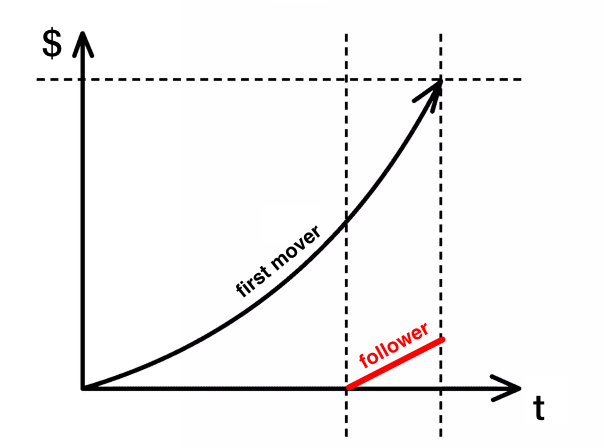
First-mover advantage (FMA) is essentially the idea that the first entrant in a new market can establish an unbeatable lead. The term entered the business lexicon after a seminal 1988 study by Stanford professors Marvin Lieberman and David Montgomery, who identified:
three primary sources of first-mover advantage
Technological Leadership: The first company working with a new technology can get ahead on the learning curve. They might secure patents or proprietary know-how, giving them a head start. For example, a pioneer in biotech might win a patent race and enjoy exclusive rights to a breakthrough drug for years.
Pre-emption of Scarce Assets: A first mover can grab valuable resources before others. This could mean locking in suppliers, buying up prime real estate, or securing exclusive partnerships. Classic example: Walmart’s founder Sam Walton was first to see the potential of big-box stores in small towns, grabbing cheap land and building a distribution network that later entrants struggled to replicate. By staking claim early, Walmart pre-empted locations and logistics advantages that competitors couldn’t easily get later.
Buyer Switching Costs and Brand Loyalty: The first significant player can start building a customer base early, and if those customers invest time or data into the product, they may be reluctant to switch. Early adopters often stick around, yielding the pioneer a loyal community. Network effects amplify this. For instance, the more buyers and sellers that joined eBay’s online auction platform early on, the more valuable the platform became for everyone, pulling in even more users in a self-reinforcing loop.
In theory, these advantages mean the first mover can define the market on its own terms. By shaping consumer expectations and standards, the pioneer becomes the reference point for all who follow. Amazon is a poster child here: it was one of the first big online retailers and used that position to set the tone for e-commerce. Jeff Bezos’s team shaped consumer preferences around online shopping (for example, normalizing the expectation of fast, reliable delivery with Amazon Prime’s two-day shipping) and built immense trust with customers early on. Amazon’s head start let it achieve massive scale – economies of scale that latecomers like traditional retailers moving online couldn’t easily catch up to. The company’s efficient operations, vast fulfillment network, and long-term supplier relationships created a moat that later entrants found “near impossible” to replicate.
So far, so good, being first sounds pretty great. However, savvy founders should note: none of these advantages are automatic or permanent. Each can be eroded by competition or missteps.
The Allure of Being First: Potential Advantages 🏆
Why do startups race to be first in the market? There are some compelling potential payoffs:
Brand Buzz & Mindshare: The first startup to introduce a novel product can capture disproportionate media attention and public curiosity. You become the name associated with the category. (Think of how Uber became synonymous with ride-hailing, ChatGPT became synonymous with LLM, or how the first mover often gets turned into a verb – “Google it,” even though Google wasn’t the first search engine!) Early buzz can help attract users, talent, and investors. If you play your cards right, your brand becomes the standard that all later entrants are measured against.
Network Effects: In many tech markets, especially platforms or marketplaces, being first helps you build network effects that snowball. We saw this with eBay – it was one of the first online auction sites and it swiftly reached critical mass. Buyers wanted to go where the most sellers were, and sellers flocked where the most buyers were, creating a self-perpetuating cycle. Similarly, Uber’s early start in ride-sharing gave it an edge in attracting drivers and riders: for quicker pickups passengers use the app with the most drivers, and drivers use the app with the most ride requests. This can kick off a winner-takes-all dynamic if the first mover can maintain momentum.
Setting Industry Standards: A first mover can often set customer expectations and technological standards in the new market. For example, Amazon’s early innovations – from 1-click online purchases (which it even patented) to two-day shipping – became industry benchmarks that every competitor had to match. The pioneer basically writes the “rulebook” that later players end up following. This standard-setting can also create switching costs: customers get used to your way of doing things. For instance, if your app’s interface or ecosystem becomes familiar and contains a user’s data or content, switching to a newcomer may feel like a hassle.
Preempting Resources & Partnerships: By moving first, startups can secure finite resources. This might mean signing up key suppliers or content providers exclusively, or locking in distribution channels. An early entrant might strike deals with important partners before competitors realize the opportunity. Imagine a first mover in a new food delivery space partnering with the majority of popular restaurants in a city – latecomers find the prime options already tied up. In some cases, being early also means you can hire top talent in that niche or scoop up intellectual property. These preemption moves can create a barrier for those who come later.
Learning and Scale Advantages: The pioneer typically has more time to experiment, learn from mistakes, and iterate on the product while others are still figuring out there’s an opportunity. This head start in the learning curve can translate into technological refinement and cost efficiencies. By the time competitors appear, the first mover might have ironed out kinks and optimized operations (assuming they survived the initial bumps). Early entry can also mean achieving scale sooner – scaling manufacturing or infrastructure in a way that lowers unit costs. In industries with high fixed costs, being first to scale can yield cost advantages that later entrants struggle to match.
Potential Monopoly (if you do it really right): In the best-case scenario, a successful first mover can become so entrenched that it enjoys a quasi-monopoly, at least for a while. If you’re the only player and you keep executing flawlessly, you might corner the market before anyone else can catch up. Some first movers have enjoyed long periods of dominance: eBay in online auctions, Netflix in DVD-by-mail (and later streaming), or Google in search (even though Google wasn’t first, it was an early fast follower that quickly dominated). First movers that sustain their lead often have some protective moat like patents, proprietary tech, or strong network effects.
Sounds great, right? It can be. But startup lore sometimes over-romanticizes the first mover. For every Amazon, there’s a Friendster. For every eBay, a Webvan. To make an informed decision, founders must also look at the flip side: the very real disadvantages and challenges that come with being the pioneer.
The Downside: Pitfalls of Pioneering ⚠️
Being first is not a free ticket to success. In fact, it often means signing up for the hardest job. Consider these disadvantages and challenges that first movers frequently face:
Market Education Costs: If you’re first, you have to educate customers from scratch about your product or service. People may not even realize they have the problem you solve. The first online learning platforms, for instance, had to convince users that virtual classes could work. When Udemy launched, it had to persuade teachers and students that online courses were a viable alternative to in-person learning. All that evangelizing and explaining can be slow and expensive. Later entrants can skip much of this – the market already “gets” the concept thanks to you.
High R&D and Setup Costs: Pioneers often pour huge investments into research, development, and infrastructure because everything is new. You’re building the tech and supply chain from the ground up without templates. It’s no coincidence that being first is often expensive. For example, Gillette reportedly spent $750M developing the Mach3 razor, only for a much cheaper-to-develop Dollar Shave Club knockoff to emerge years later and undercut it. First movers face unknown costs and trial-and-error spending that fast followers can avoid or minimize by copying what works.
No Prior Blueprint: As the pioneer, you have no precedent to learn from – you are the precedent. Mistakes are inevitable, whether it’s a flawed product assumption, a pricing error, or technical growing pains. The tragedy is that your startup might not survive those mistakes, even though followers will learn from them. Look at Friendster, the social network trailblazer: it gained millions of users quickly but struggled with technical scaling issues and user management. The site became slow and unreliable under the growth strain. Those stumbles drove early adopters away – directly into the arms of a young Facebook, which had watched and learned what not to do (e.g., controlling growth and building a robust infrastructure to avoid crashes). In essence, Friendster took the arrows, and Facebook reaped the rewards of a better execution. Being first means you’re the one hacking through the jungle, and the ones behind you get to follow the trail you blazed, possibly faster and with fewer cuts.
Competitive Onslaught: The moment you prove a market is promising, expect a swarm of competitors. Your very success paints a target on your back. Fast followers and established companies alike will rush in, often with more resources. Being first means “war” – everyone will come for your market share. We’ve seen it time and again: Meerkat, a pioneer in mobile live-streaming, had initial buzz, but as soon as Twitter (with Periscope) and Facebook rolled out similar features, Meerkat was cut off at the knees and died in 2015. Craigslist was the first big online classifieds site, but later niche services (like Airbnb using Craigslist to find apartment listings) picked its business apart. The first mover essentially lights the way – and paints the bulls-eye on themselves. If you’re first, you need to be ready to fight off wave after wave of challengers.
Regulatory and Industry Pushback: Often, a disruptive first mover faces a world not ready for them, including laws and regulations. Innovating in uncharted territory means you might clash with existing regulations or spark new ones. Just ask Uber. Uber pioneered the ride-sharing model in the early 2010s and quickly encountered fierce resistance from city regulators, taxi unions, and lawmakers who didn’t know what to make of it. Uber’s service was suspended or banned in numerous countries as laws scrambled to catch up. Being first can mean spending years in legal battles or lobbying, costs that followers might mostly avoid once the regulatory landscape has adapted. Theranos is a darker example: it was a first mover in unproven blood-testing tech, charged ahead (and eventually turned out to be fraudulent) – leaving a trail of stricter scrutiny for any startups that follow in biotech diagnostics. If you’re first to “shake up an industry,” be prepared for the industry and government to shake back.
All Eggs in One Basket: Pioneers often have to go all-in on the new idea, which raises the stakes. Because being first is resource-intensive, startups may have nothing else to fall back on if the idea flops. That can lead to spectacular failures. Remember Google Glass? Google’s futuristic eyewear was a bold first mover product that faced immature technology, privacy concerns, and user confusion about its purpose. Google sank a lot of prestige and money into it, only to shelve Glass in 2015. Years later, other companies are slowly picking up where Google left off – basically validating the space after Google bore the brunt of the initial failures. First movers carry the risk that if the single big bet fails, there’s no safety net. Especially for a startup with limited funds.
Risk of Complacency: Paradoxically, if you do achieve early success as a first mover, you might fall prey to your own victory. Complacency is a well-known danger: you think you’re so far ahead that you slow down. This happened historically with Ford. Ford Motor Company was the first major player in automobiles and by the 1920s had a colossal market share lead. But that dominance made Ford rest on the Model T, while General Motors aggressively innovated with new models and features. Within a decade, GM overtook Ford. The lesson: being first can breed hubris. In the tech world, we saw a similar pattern with early social networks and search engines that didn’t evolve (Friendster, MySpace, AltaVista, etc.) getting outpaced by hungry later entrants (Facebook, Google). The first mover advantage can evaporate if you assume competitors will forever stay behind you.
Defense Fatigue: A successful first mover must play constant defense. Once you’re on top, everyone is gunning for you, trying to out-innovate, undercut prices, or mimic your features. This can lead to what some call “defense fatigue” – the pioneer is so busy fending off challengers and responding to attacks that it gets tired and loses creative edge. The culture can shift to reactive instead of proactive. Meanwhile, fast followers can sometimes maneuver with agility since they’re attacking, not defending. This dynamic means staying on top as a first mover often requires even more effort and reinvention than the initial climb to the top.
In short, being first means doing the hardest work and taking the biggest risks, only some of which will pay off. It’s worth dispelling the myth that first movers always win. In fact, research examining the dot-com era found that many first movers failed, and the ultimate winners were often those who entered at the right time with superior execution. Timing is everything. There is no early-mover advantage, just as there is no late-mover advantage. What matters is entering a market at the moment when you can capitalize and survive, given your resources.

Case Studies: First Movers vs. Fast Followers
Friendster vs. Facebook
In the early 2000s, Friendster was the pioneer of social networking. It launched in 2002 and rapidly amassed millions of users, proving there was huge demand to connect online with friends. But Friendster became a victim of its own early success – its site couldn’t handle the traffic (slow load times and crashes were common), and users began to flee. By the time Friendster tried to fix its issues, a fast follower was emerging. Facebook launched in 2004 with a controlled, campus-by-campus rollout and a clean user experience. Facebook essentially learned from Friendster’s mistakes, avoiding rapid scale until the product was ready and presenting itself as a “safe,” reliable platform. Once Facebook opened to the public, Friendster’s remaining users had every reason to jump ship to the smoother, more robust network. Friendster, despite its first-mover advantage and innovative idea, couldn’t capitalize on its lead – it was overtaken and eventually shut down in 2015. The social media crown went to a later entrantthat executed better when the market was truly ready. Today, Facebook’s triumph is often cited as proof that being the best can beat being the first.
Amazon vs. the Brick-and-Mortar Giants
Amazon is an example of a first mover that not only survived but thrived spectacularly, but it wasn’t easy. When Amazon started selling books online in 1995, it was entering uncharted territory: e-commerce was new and unproven. Amazon had to build trust in online shopping from scratch and invest heavily in infrastructure (warehouses, distribution, website tech) before the payoff came. It took years before Amazon turned a profit, but being an early mover allowed it to define e-commerce standards and accumulate advantages that later brick-and-mortar giants struggled to catch up with. Amazon’s head start meant it had years to refine its logistics and customer service ethos. It locked in millions of loyal customers with efforts like Prime, leveraging its early-mover scale to set unbeatable shipping speeds. As e-commerce became mainstream, who was positioned to dominate? The company that wrote the playbook in the first place. Crucially, Amazon never became complacent – it kept expanding and innovating (marketplace sellers, AWS cloud services, etc.), essentially out-competing itself before others could. The result: Amazon is one of the world’s most valuable companies and is widely recognized as a pioneer of online retail. Its story shows that first movers can win big, but it often requires relentless execution, deep pockets, and a willingness to continually reinvent even after you’re on top.
Uber vs. Lyft
Uber often gets cited as a first mover winner, having popularized ride-hailing globally. By moving first in 2010, Uber quickly amassed drivers and riders in cities worldwide, benefiting from strong network effects (more riders attracted more drivers, and vice versa). Uber’s early aggressive expansion helped it become the default name in its industry. However, Uber’s tale also illustrates that first mover advantage can have limits. Lyft, a fast follower launched a few years later, competed effectively in the U.S. by differentiating itself with a friendlier image and often by learning from Uber’s early PR and regulatory stumbles. In some markets, Uber also faced local competitors (like Didi in China or Grab in Southeast Asia) that eventually outpaced Uber on their home turf. Moreover, Uber’s first-mover status put it under intense regulatory scrutiny – it had to spend years fighting legal battles and city hall wars to legitimize ride-sharing. Lyft, coming later, navigated a somewhat clearer path as regulators by then had frameworks to handle this new industry. Today, Uber remains the larger player globally, but it’s had to share the ride-hailing space with formidable followers. The Uber story is still unfolding, but it underscores that being first gave a head start, not a permanent monopoly. It had to continuously innovate (UberEATS, scooters, etc.) and improve its image to stay ahead. The race between first mover and fast follower here shows the gap can close quickly – and the winner will be whoever best adapts, first or not.
• • •
Many other case studies echo similar themes: Yahoo was the early king of search and web portals, but it lost focus and was eclipsed by Google’s superior technology and clarity of vision. MySpace rode the first major wave of social networking but faltered due to poor management and was overtaken by Facebook. Pioneering products like the IBM Simon (the first smartphone) flopped, while later entrants like BlackBerry, and Apple with iPhone, learned from those early attempts and built far better devices. First-mover advantage is real, but it’s not a guarantee. Execution, timing, and adaptability ultimately decide the outcome.
TL;DR for Startup Founders
So, how should a founder decide whether to pursue a first-mover strategy or be a fast follower? Here are some key considerations and actionable insights:
Assess Market Readiness: Is the world ready for your idea? If you have to spend enormous effort and money just to educate customers on what your product is and why they need it, you’re essentially paving the way for everyone else. It might still be worth doing (if you have the resources and a plan to maintain your lead), but be aware that being too early can kill a startup. Entering at the right time can be more important than being first. Many failed first movers were simply ahead of their time (and budget). If you’re too early and under-resourced, you risk drowning before the market matures. Sometimes it pays to let someone else crack open the market and then enter once consumers are more receptive.
Identify Your Sustainable Advantages: If you do go first, stack the deck in your favour. Ask yourself: what will prevent a competitor from swooping in and doing this better or cheaper? Try to build or acquire real moats, e.g. proprietary tech or patents, exclusive partnerships, a strong community, or network effects that increase with scale. The original formula for first-mover success still holds: you want appropriable technology, control of key resources, and ways to lock in customers. And if you can add network effects on top of that, even better. In other words, being first isn’t enough alone; you need something else to keep you ahead (superior tech, a data advantage, etc.). Make sure those advantages are hard for a follower to replicate quickly.
Plan to Iterate and Improve Continuously: Treat first-mover advantage as temporary unless you continuously earn it. The mindset of a successful pioneer is almost paranoid – assume competitors are right behind you (because they are). Don’t get complacent with an early lead. Keep innovating, invest in scalability and reliability, and even be willing to reinvent your business model if needed. Amazon didn’t stop at selling books; it became a logistics powerhouse and cloud computing provider. The moment you rest on your laurels, a fast follower can catch up or consumer preferences can change. First movers very rarely get it right immediately. Clever fast followers watch, and figure out the right recipe. To stay ahead, the first mover must be willing to act like a follower at times: learning, adapting, and improving constantly.
Budget for the Long Haul (or Don’t Go First): Being first often requires deep pockets or a creative strategy to endure losses. If it’s going to take years of red ink to educate the market or develop infrastructure (think of Uber subsidizing rides or Amazon losing money on books to gain users), do you have the capital and investor patience for that? If not, a fast-follower approach might be saner. A “fast late arrival” strategy – entering after the pioneers have proven the market but before it’s crowded – can be smart. Many successful startups were exactly that: they let someone else go first, then swooped in with a better product at the right moment. As a founder, be realistic about your runway and whether you can truly afford the first-mover learning curve.
Develop a Plan B (and C): Because all your eggs might be in one basket as a pioneer, always consider contingency plans. What if the market evolves differently or a giant competitor copies your idea? Can you pivot or differentiate further? Early pivot flexibility can be a lifesaver for first movers. And if you find yourself not first in a space you wanted to lead, it’s not game over – you can pivot to a niche, out-innovate the leader on product quality or focus on a specific segment they’re neglecting. Being second or third is often an advantage if you can pinpoint where the first mover faltered (e.g., focus on reliability, customer service, or a different demographic). In short, whether first or not, agility is a founder’s friend.
Know Your Endgame: Not every first mover needs to conquer the world themselves to succeed. Sometimes the goal might be to prove a concept and then exit strategically. E.g., Instagram wasn’t the first photo-sharing app, but it was early and good, and it sold to Facebook, effectively cashing in on its lead. If you’re going first in a market that will eventually have bigger players, consider whether your best outcome is to be acquired after you validate the space. Many large companies prefer to buy pioneers once risk is reduced. A viable strategy for startups is to stake out territory and defend it as a first mover, then partner with or sell to an established firm. It can be a win-win: you get rewarded for pioneering, and the larger company scales the idea.
Conclusion
First-mover advantage is neither a guaranteed golden ticket nor a complete myth – it’s a strategy with trade-offs. The decision to be first should hinge on your specific market conditions and your startup’s capabilities. If the rewards of being early (network effects, brand dominance, etc.) are high and you have a way to protect and capitalize on that lead, going first can indeed confer a big advantage. But if the path is unclear, the costs too high, or your solution not quite ready for prime time, you might actually benefit from letting someone else go first and then out-executing them as a fast follower.
Remember that timing and execution often outweigh simply “being first.” There is no single best time to enter a market – not too early, not too late, but when you’re prepared to deliver. The early bird may get the worm, but the second mouse gets the cheese. For startup founders, the real advantage comes from being the best mover, not just the first. Whether you choose to pioneer or to patiently perfect an idea that’s already out there, success will come from how well you understand your market, learn from others, and play to your startup’s strengths. Good luck!