We Analysed 100 Viral Products and This Is What We Found Out
Do you know what separates apps people obsess over from apps people delete after a week? This year, I went down a rabbit hole. I started pulling apart products: apps, platforms, tools, that had grown without massive ad budgets or splashy marketing campaigns. Instead of buying attention, they earned it. No paid acquisition, just products that spread because people couldn't stop talking about them.
After going through 100 of them, from Wordle to BeReal, from Duolingo to Clubhouse, from Notion to TikTok, some clear patterns emerged. Not tricks or hacks. Structural decisions that made virality inevitable. Here's what I found.
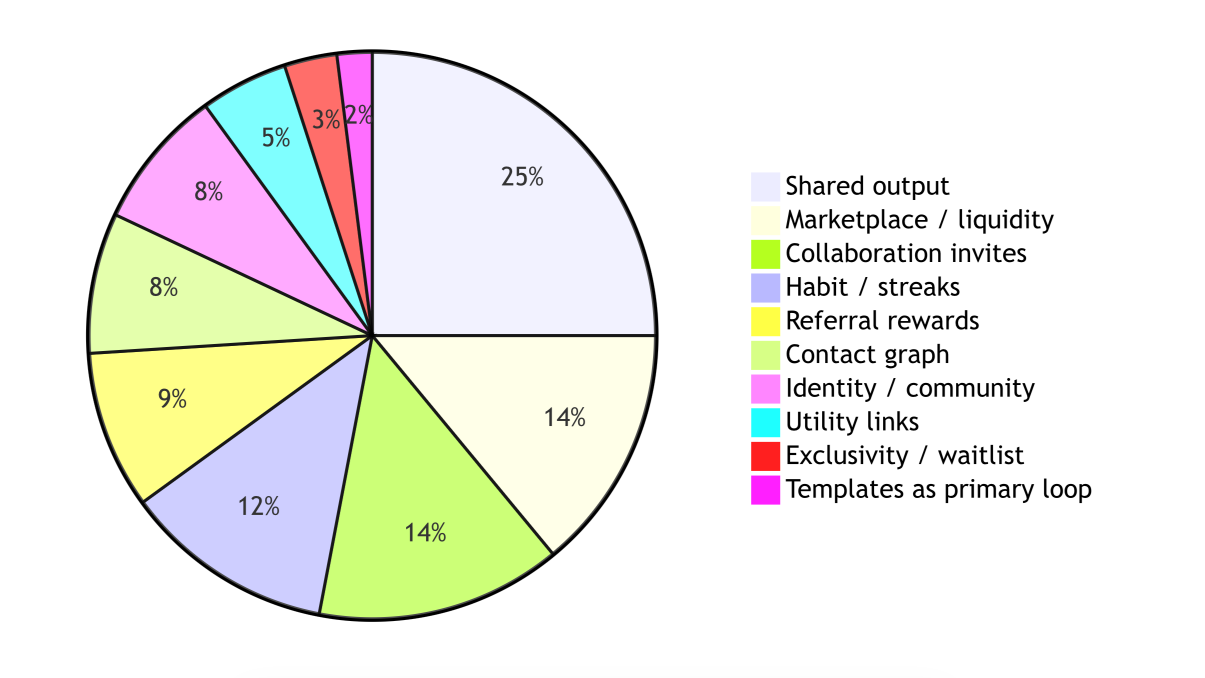
Dominant viral mechanic across the 100-product dataset
How this research was done
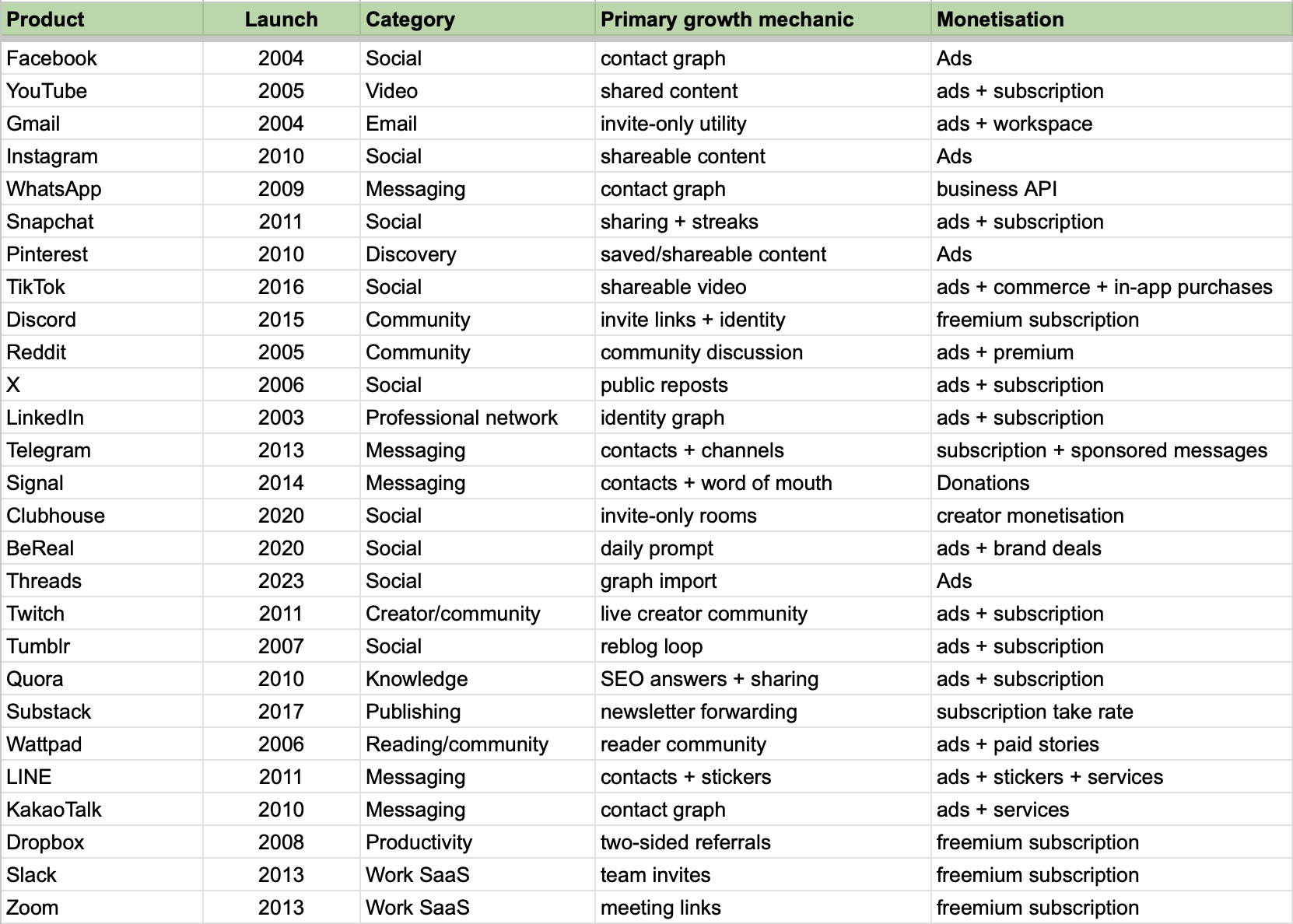
We built a structured sample of 100 products launched between 1999 and 2026. A product made the list if it had public evidence of at least one of these mechanics: shareable output, collaboration invites, contact-graph seeding, referral rewards, scarcity or waitlists, local network density, identity/community loops, or an embedded utility link. The source mix prioritised official and primary materials where possible: product pages, pricing pages, launch posts, help-centre articles, developer docs, and company blogs. We supplemented those with case material and reputable tech press when official sources did not explain the growth loop clearly. The full table is here.
1. Create "The Aha Moment" in Under 60 Seconds
Every viral product I studied had one thing in common: you got it almost immediately. Wordle doesn't explain itself. You just start guessing words and the coloured tiles teach you the rules in real time. Instagram didn't need a tutorial. You took a photo, applied a filter, and suddenly your lunch looked like it belonged in a magazine.
Most founders spend months on onboarding flows, walkthroughs, and tooltips. Viral products spend that time on collapsing the gap between sign-up and the first moment of genuine value.
Ask yourself: how long does it take a brand new user to feel the magic? If it's more than 60 seconds, that's your biggest problem.
2. Built to Be Shown Off
The second thing that jumped out at me: almost every viral product creates something shareable by design, not as an afterthought.
Spotify Wrapped is the clearest example. It's not a feature. It's a yearly event that turns every user into a marketing channel. When you share your Wrapped, you're not promoting Spotify — you're expressing your identity. Spotify just happens to be the vehicle.
The same goes for Duolingo's streak screenshots, and BeReal's dual-camera format. Each of these creates a native artefact, something visual, personal, and worth sharing, that spreads the product to a new audience without feeling like an ad.
Before you ship your next feature, ask: does this create anything worth sharing? Not a boring referral code, not a "tell a friend" button. An actual moment someone would want to put on their stories.
“Viral products make value visible to the next person”
3. Tap Into a Pre-Existing Behaviour
Here's one that surprised me. Very few of the viral products I studied were asking people to do something new. They were packaging something people already did, but doing it better, or making it social, or making it fun.
TikTok didn't invent short video. People were already watching YouTube clips and Vines. TikTok made discovery effortless and creation fast. Notion didn't invent note-taking. People had been using Word documents and sticky notes for decades. Notion made structure feel creative. Duolingo didn't invent language learning. It turned what was already a desire (I should learn Spanish) into a daily habit with game mechanics.
Virality rarely comes from inventing a new behaviour. It comes from being the best version of an existing one. When you're building, ask: what are people already trying to do that your product can make easier, faster, or more satisfying?
4. Habit Loop Pulls You Back
Every sticky product has a habit loop. Something that brings you back. Duolingo's streak is the textbook example. Miss a day and your streak breaks. That's not just a reminder — that's a loss. And humans, as any behavioural economist will tell you, are far more motivated by avoiding loss than by gaining something new.
Games have understood this forever. Daily challenges, energy systems, leaderboards — these are all mechanisms that create a reason to come back. But the best mobile apps outside of gaming have figured this out too.
BeReal sends a random notification once a day. You have two minutes to post. If you don't, your friends know. That tiny mechanic drove millions of downloads not because the product was technically impressive, but because the loop created social stakes. Design your habit loop before you design your features.
5. Spread Through Trust Networks, Not Advertising
When I looked at how users were actually discovering these products, one channel came up again and again: a friend told them. Not an influencer. A friend.
This sounds obvious, but the structural implication is often missed. Products that spread through trust networks need to be easy to invite people into. Frictionless to share. Immediately useful even before your entire network is on board.
Notion cracked this with its template ecosystem. Someone would share a Notion template, a stranger would open it, see the product in action at its best, and sign up. The template was a trojan horse — a piece of value that required downloading the product to unlock.
WhatsApp spread because group chats broke if one person wasn't on it. The value of the product scaled with the number of people in your network who used it. That's a textbook network effect, and it made every user a recruiter.
What's your product's equivalent? How does it naturally pull new users in, through the people who already love it?
6. Make Users Feel Something
This one is harder to engineer, but it's the difference between products people use and products people love.
Headspace makes you feel calmer. Strava makes you feel like an athlete. VSCO makes you feel like a photographer. These products attach themselves to an identity the user wants to have, and then deliver on it.
The viral products that felt shallow tended to be good at triggering novelty but bad at creating emotion. They spiked and faded. The ones that built genuine communities attached themselves to something users cared about beyond the app itself.
Ask yourself: after using your product, how does a user feel about themselves? Not about your product — about themselves. If the answer is neutral, you're building a utility. That can be a great business. But it won't go viral.
7. Remove One Major Friction Point, Accepted as Normal
Almost every viral product I studied did something that made incumbents look lazy in hindsight. They took one friction point that everyone else had accepted as just the way things are, and they eliminated it.
Calendly removed the back-and-forth email of scheduling meetings. "When are you free?" was a problem so common that nobody thought to solve it. Then Calendly did, and it spread through every shared calendar link.
Cash App removed the process of entering bank details to send someone money. A cashtag made it as easy as tagging someone on Instagram.
Loom removed the need to schedule a meeting just to explain something. Record a video in 30 seconds, send a link, done.
In each case, the existing pain was hiding in plain sight. The category had normalised it. The viral product refused to.
What pain has your category normalised? What does your user do today that they would be embarrassed to still be doing five years from now?
8. Business model
Your business model design matters a lot. Most winners in my research did not try to charge before first value. The dominant revenue shape was free entry, then paid depth: subscriptions, premium tiers, enterprise controls, take rates, ads, or transaction fees. Tech press still describes freemium as tightly linked to product-led growth rather than as a pricing gimmick. TechCrunch’s SaaS coverage argues that freemium works when users can understand value very quickly.
Founder move: keep the viral action outside the paywall. Charge for power, volume, admin, privacy, speed, exclusives, or enterprise features. Watch out for locking the loop itself behind payment, or subsidising growth so hard that the product attracts low-intent users who never convert.
9. Retention
Retention is the hidden engine. A clever invite mechanic may create a spike, but sustained growth usually comes from repeat use. Retention and engagement now matter more than old spammy invites. If users do not stick, they do not keep inviting, sharing, or contributing. Duolingo says its streak gives learners a measurable reason to practise daily, and it now even offers Friend Streaks. Snapchat’s own support pages explain that both people must send a Snap every day to keep a streak alive. BeReal’s daily notification compresses the same idea into a two-minute social window. These products are not viral because they spread once. They are viral because they give users a reason to come back and spread repeatedly.
Founder move: attach the loop to a natural rhythm: daily learning, daily sharing, repeated work, weekly clubs, or social accountability. Watch out for shallow gamification. If streaks are not tied to real value, users will eventually resent them.
10. Timing is Part of the Product
The last pattern is the hardest to manufacture, but the most honest to acknowledge. Timing matters. A lot.
More than half of researched products launched between 2009 and 2015, the era when smartphones, contact graphs, app stores, and social sharing became everyday behaviour. That is why so many lasting viral mechanics still look mobile-native: your camera, your contacts, your notifications, your location, your feed, and your message threads are still the main “distribution rails” for consumer software.
Zoom wasn't a new idea. Video calling had existed for years. But Zoom launched its consumer-friendly version just before the world needed remote communication at a massive scale. The product was good. The timing was extraordinary.
Clubhouse launched at a moment when people were locked indoors, craving the feeling of being in a room with interesting people. The product matched the cultural moment so precisely that even its exclusivity (invite-only) became a feature.
This doesn't mean you should wait for the perfect moment. It means you should pay attention to what's changing in the world and ask whether your product is suddenly more relevant than it was six months ago. Markets shift, behaviours change. The product that felt too early in 2019 might be perfectly timed in 2026.
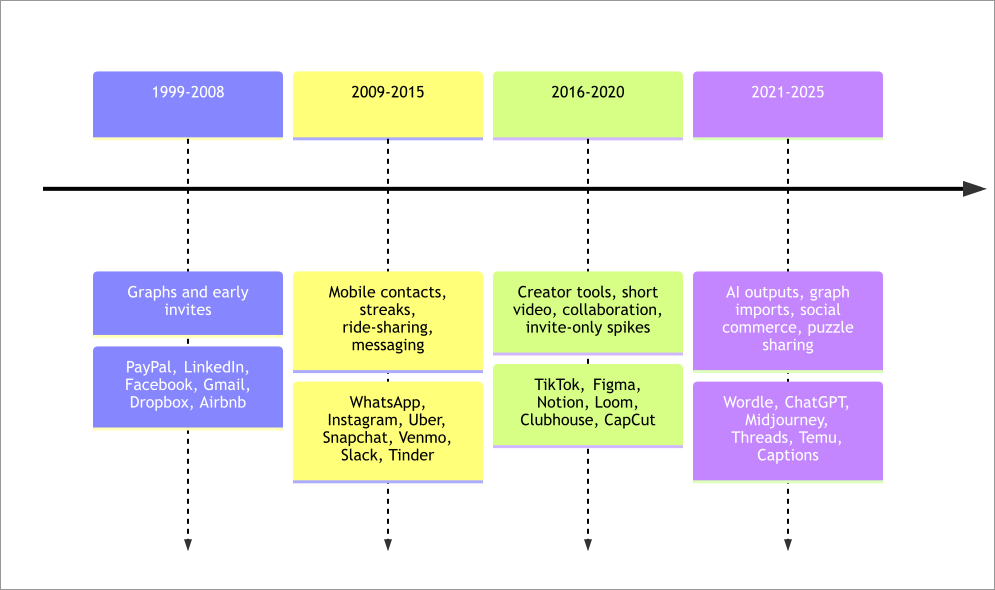
How viral product design shifted with time
Measurement that matters
Any article about viral products wouldn’t be complete without mentioning the famous “viral coefficient” (also known as the K-factor, or simply K). Think of it like word-of-mouth, but measurable. It answers one simple question: “How many new users does one user bring in?”. Here is the math:
if K < 1 — growth dies.
if K = 1 — you’re stuck.
if K > 1 — growth compounds. That’s when things get scary… in a good way.
If you want to build a viral product, measure spread and staying power together. K-factor tells you how many new users each existing user brings in. Viral cycle time tells you how quickly the loop compounds. Retention tells you whether the loop keeps producing new exposure over time. DAU/MAU and the Power User Curve tell you whether you are building real habit or just a thin layer of occasional users. DAU/MAU is helpful but limited, while the Power User Curve shows how deep usage really is across segments and markets.
Summary
After going through 100 products, here's the lesson I keep coming back to:
Viral products don't feel like products. They feel like experiences people want to share.
They're fast to value, easy to spread, built around identity, and designed to pull people back. They solve a real problem, but in a way that makes users feel clever, creative, or connected for using them. None of this is luck. It's a series of deliberate decisions made early in the design process, long before growth becomes someone else's problem. The founders who built these products weren't better marketers. They were better product thinkers. They made virality structural. Viral products do not ask users to market the product; they let users finish their own job in a way that naturally brings the next user in.
The Takeaway: find the absolute smallest unit of value your user can create or share, and make that action friction-free, safe, and deeply rewarding. When done right, virality isn't a cheap growth hack, it is the natural byproduct of a product working exactly as intended. Dropbox turned storage into the reward. Calendly made the invite the advertisement. Figma weaponized collaboration, Wordle turned daily results into a status symbol, and WhatsApp transformed your address book into an instant network. Stop trying to hack growth. Build it into the very first line of code. Good luck!