
The Lean Product Playbook - Book Summary
Many teams can explain Lean Startup perfectly in a meeting. They know what product-market fit means. They can describe the build-measure-learn loop. They understand why MVPs should test assumptions instead of just shipping features. But the trouble begins when theory meets the messy reality of building a product. What exactly should they build first? Which assumption should be tested? What metric proves the experiment worked, how many users are enough?
This is where many teams get stuck. Lean Startup gives them the right mindset, but not always the operating system. The concepts are valuable, but without clear steps, and decision rules, teams can easily turn “learning fast” into random experiments, endless discussions, or yet another roadmap full of untested features.

Dan Olsen, the author of The Lean Product Playbook, offers the method for turning the fog around product‑market fit into a structured set of hypotheses, then validating those hypotheses with rapid customer feedback. The method combines a clear definition of product‑market fit via the Product‑Market Fit Pyramid with an execution loop via the Lean Product Process.
For startup teams the payoff is practical: a repeatable workflow to (a) choose a specific target customer, (b) identify underserved needs, (c) craft a differentiated value proposition, (d) pick a minimal feature set, (e) prototype rather than overbuild, and (f) run customer tests in waves that generate actionable learning.
If Inspired shows you what great product teams look like, The Lean Product Playbook shows you how to begin working like one. It’s a practical blueprint you can apply in your day-to-day work.
“The ultimate measure of product/market fit is retention rate.”
The founder’s dilemma this book tackles
Picture a familiar scene: your small team has three engineers, one designer, and a runway that ticks louder every week. The temptation is to equate progress with shipping: tickets closed, screens polished, another feature added… but it doesn’t help.
Teams routinely struggle to apply Lean ideas because they lack specific guidance on what to do and how to do it. The Lean Product Playbook positions itself as the “how‑to” manual that operationalises Lean product development into concrete steps and artefacts. Two important themes:
Product‑market fit isn’t a vibe. It’s a structured fit between market and product hypotheses: target customer + underserved needs aligned with value proposition + product user experience.
Founders must resist ‘solutions‑first’ thinking. This is the difference between the problem space (benefits, needs, outcomes) and the solution space (features, UI, implementation).
That distinction matters because it changes what you validate first. If the real issue is that you picked the wrong customer - no amount of interface polishing can rescue you.
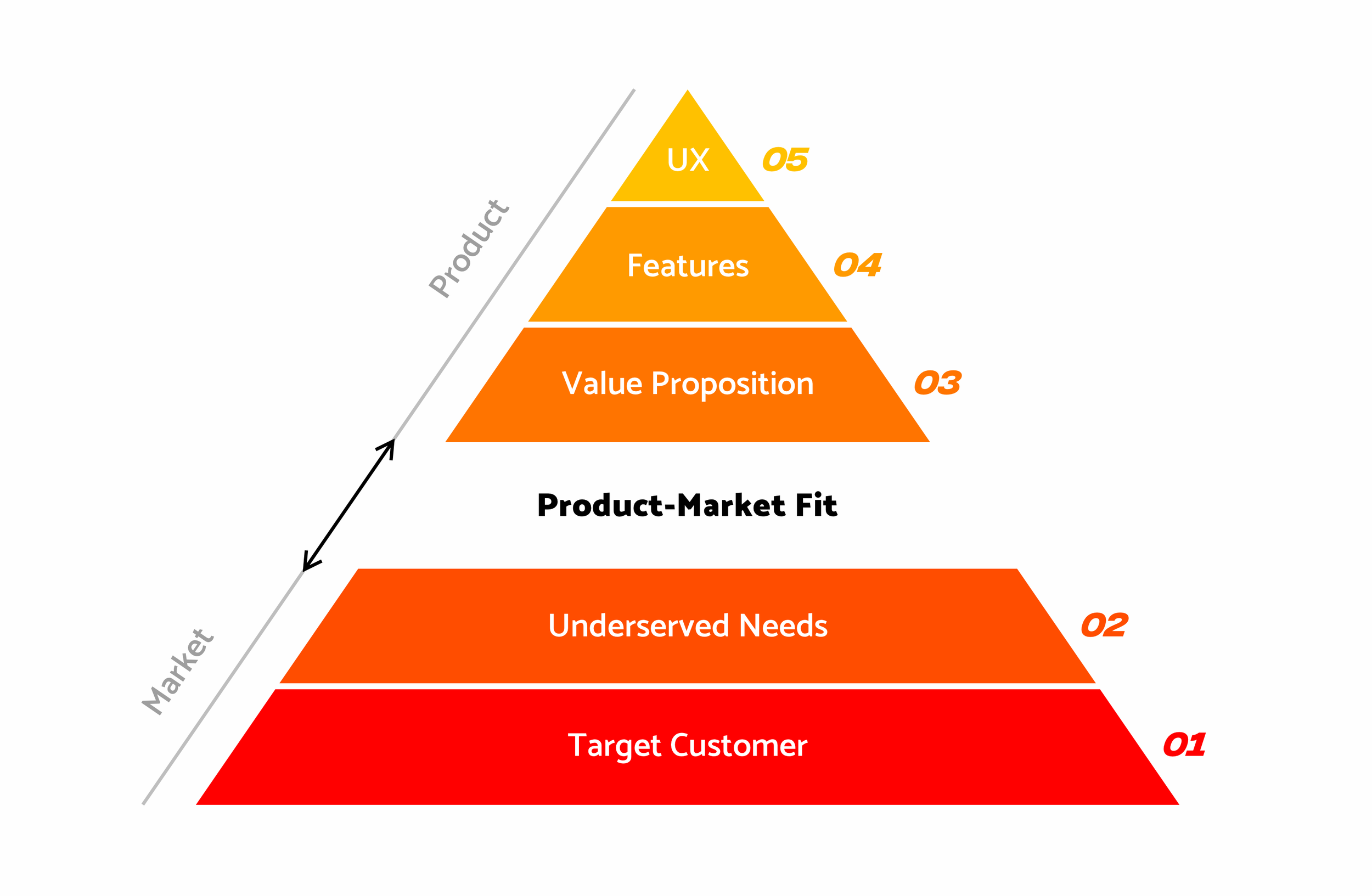
Product‑Market Fit Pyramid
Olsen’s definition of product‑market fit is encoded in a simple hierarchy: five components that build on one another. The Lean Product Process guides you bottom‑up through those layers: determine target customer, identify underserved needs, define value proposition, specify MVP feature set, create MVP prototype, test with customers, then iterate.
A key nuance from author: he prefers an explicit Hypothesise → Design → Test → Learn framing, because teams can misread ‘build’ as the default first move, when building is usually the most expensive action.
1. Determine your target customer
Target customer isn’t a demographic slogan, it’s a shared, written artefact that aligns decisions. A practical tool here is the one‑page persona. What a strong persona should include: needs/goals and success criteria, behaviours, current workaround and frustrations, usage context (where/when), adoption characteristics. It should fit on a single page.
Founder tip: treat the persona as a living hypothesis. If feedback splits (half love vs half don’t), the signal often isn’t “people are fickle”, it’s “your segment is still too broad”.
Common pitfall: writing personas from imagination, then defending them. Get first‑hand contact with customers, because teams often believe they’re customer‑centric but can’t recall when they last spoke to customers directly.
2. Identify underserved needs
This is the engine room. ‘Needs’ must be defined as benefits/outcomes, not features. A concrete prioritisation method Olsen teaches is the Importance vs Satisfaction framework: map problems on an XY scatter plot where importance is on the Y-axis and satisfaction with current alternatives is on the X-axis; the “high importance / low satisfaction” region is where opportunity concentrates.
Founder tip: avoid “ready, fire, aim” feature launches by forcing the team to label needs in the problem space before designing solutions.
Common pitfall: confusing noise for insight. Olsen’s guidance emphasises using rating scales and aggregated results for mapping, because individual feedback varies, but patterns should cluster.
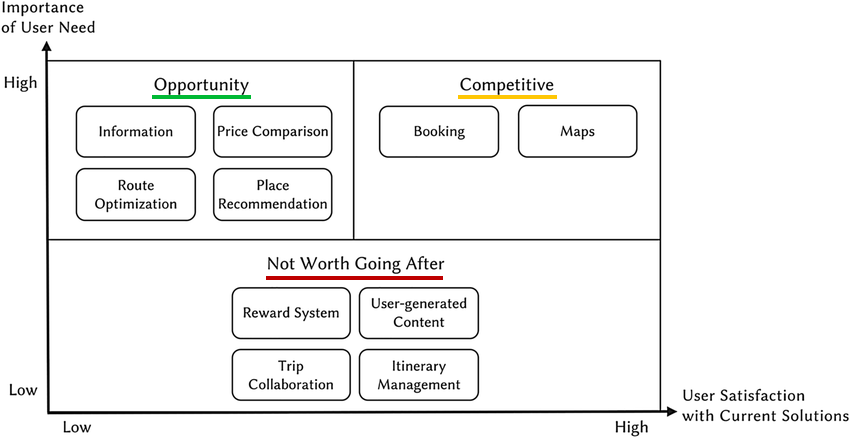
The Importance vs Satisfaction map example for a travel planner app
3. Define your value proposition
Value proposition is not a marketing tagline. It’s a strategy choice: which needs you’ll address, and how you’ll beat alternatives. A practical template is the Product Value Proposition Template (aka Value Proposition Grid), which compares ‘My Product’ to competitors across must‑haves, performance benefits, and delighters. It’s a simple, visual, and highly effective way to sharpen product focus.
Founder question to pressure-test: “If a customer already uses Competitor A, what makes switching rational, and what makes it emotional?” The template helps you spot whether you’re just matching must‑haves (table stakes) rather than creating a reason to choose.
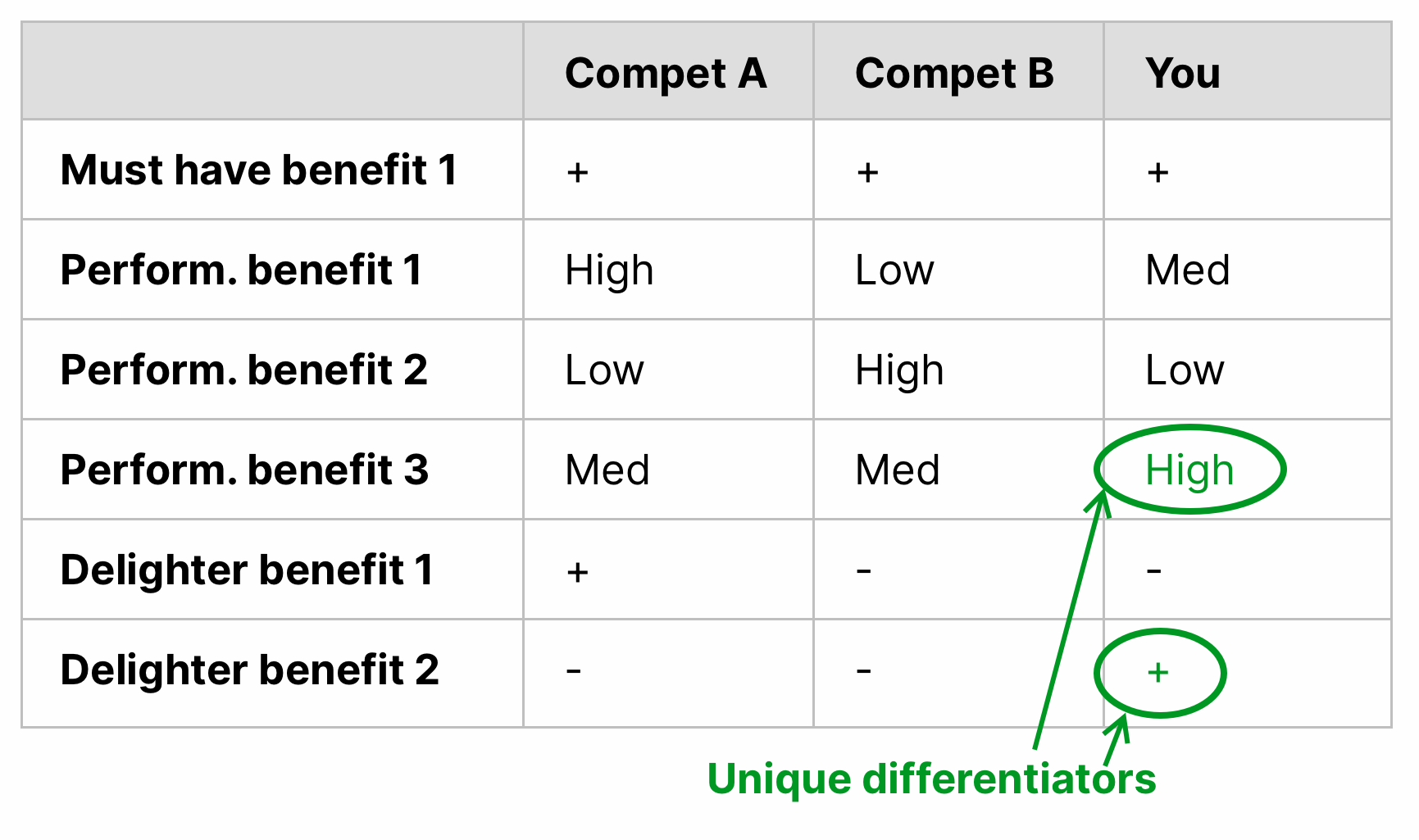
Value Proposition Grid example
4. Specify your feature set
MVP is not about the minimum feature set. It’s about the smallest experience that solves the core need. Features are downstream: you don’t pick them because they’re exciting; you pick them because they deliver the chosen benefits. The Lean Product Process calls this out explicitly as the MVP feature set step. The point is to avoid investing heavily only to learn later you built the wrong thing.
Founder tip: draft features as testable hypotheses (e.g., “If we provide X, persona Y can complete job in under 2 minutes”) and delete any feature that doesn’t test a core hypothesis for fit.
Common pitfall: mistaking MVP for version 1 of the future full product. MVP framing is about proving/disproving assumptions tied to the value proposition, not shipping a shrunken full suite.
5. Create your MVP
Prototype is a faster, cheaper stand‑in for a working product, especially for web and mobile. Prototypes are representations you can build without engineering the full product, varying by fidelity and interactivity (from sketches to clickable mockups), and specifically highlights clickable/tappable prototypes for eliciting useful feedback.
Founder tip: set a “no code unless…” constraint. If you can test the hypothesis with a prototype, don’t pay the engineering tax yet.
6. Test with customers
This is where many teams “do research” but don’t learn. Here is the advice:
Confirm screener fit, so participants actually match your target customer.
Task-based walkthrough with prototype (observe actions + confusion).
Avoid leading and closed questions. Use open-ended questions that elicit feelings and explanations for better learning from user tests.
Capture top positives, top blockers, and a simple value/ease rating.
Run 5–8 sessions, stop, synthesise patterns, iterate, repeat.
Book’s companion materials even show a lightweight way to track user-test results, mixing qualitative observations (feature/messaging/UX feedback) with simple numeric ratings such as “How valuable?” and “How easy to use?”.
Founder tip: try to obtain a commitment that reduces politeness bias: time (schedule another session), money (pay for early access), or reputation (introduce colleagues).
Metrics
The book’s structure explicitly moves “beyond MVP” into measuring key metrics and applying analytics. Olsen’s metric north star is retention. Retention is the ultimate measure of product‑market fit, with retention curves and cohort improvement as the empirical story of “fit getting better.”
For practical dashboards you can use the AARRR metrics framework (Acquisition, Activation, Retention, Referral, Revenue) as a way to organise outcomes across the funnel:
Acquisition: channel to qualified visits;
Activation: first ‘aha’ moment rate;
Retention: cohort curves / returning users;
Referral: invites, shares, word-of-mouth loop;
Revenue: conversion, ARPU, expansion.
Takeaway for founders: metrics don’t replace qualitative learning, they sequence it. Olsen explicitly argues that qualitative methods are especially effective when defining a new product (discovering customers and needs), with quantitative methods becoming more powerful as you narrow variables and scale.
“Treat product‑market fit as hypotheses you can write down, test, and revise, not as a supernatural moment you ‘feel’”
Case studies
Great products rarely happen by accident. They are shaped through customer focus, fast experiments, and brutal prioritization. To see Product-Market Fit Pyramid in action, let’s look at four real-world case studies where these theoretical principles guided startup decisions.
Tesla Roadster: Defining the Target Customer
Tesla did not start with an affordable mass-market electric car. They began at the very base of the pyramid by identifying a highly specific Target Customer: wealthy early adopters who valued performance, status, and sustainability. Tesla’s early value proposition was never “cheap transportation” — it was “electric can be desirable”. By narrowing their focus, they didn’t have to convince the masses to buy an EV, they only had to convince the segment most eager to believe.
Calendly: Pinpointing the Underserved Need
Calendly succeeded by obsessing over a boring but painful Underserved Need: the endless, frustrating back-and-forth of scheduling meetings. The value proposition was crystal clear because it solved that one specific job better than any default alternative. Calendly won because it didn’t try to reinvent the calendar — it simply eliminated the most annoying part of using one.
Figma: Out-Positioning the Competition
Figma entered a fiercely crowded design market, proving that product-market fit doesn’t always require inventing a new category. Instead, they focused on a glaring gap in the existing market’s Value Proposition: real-time collaboration. Figma didn’t win because designers needed a better pen tool. It won because design teams had become collaborative, but their software had not.
Notion: Iterating the MVP and UX
Notion’s journey reminds us that finding product-market fit is a process, not a single launch. The product evolved into a flexible, all-in-one workspace only after years of iterating on its Feature Set and User Experience. It illustrates the danger of assuming your first hypothesis is correct. Notion’s success came from listening to the market and refining the product until its supreme flexibility became its winning value proposition.
Common pitfalls founders fall into
A frequent failure mode is confusing enthusiasm for progress with evidence of fit. Olsen’s framework forces you to make the chain explicit: customer → needs → value → features → UX. If any layer is wrong, polishing the layer above is wasted motion.
Another pitfall is overscoping the MVP. Teams ironically overscope the MVP, the book recommends anchoring scope debates in the target customer and the value proposition, because resources are limited.
A third pitfall is bad testing hygiene, especially leading questions and poor participant fit. Leading or closed questions turn tests into compliments. Olsen explicitly warns against such questions and stresses screeners so you generate actionable learning, and don’t iterate in the wrong direction.
Fourth is premature optimisation: instrumenting everything, polishing micro‑UX, or scaling acquisition before the product is sticky. Author advises not to obsess over premature optimisation before getting in front of customers and iterating based on learning.
Finally, mistaking activity metrics for fit. Sign-ups can be driven by marketing polish; retention and cohort curves are harder but more honest.
The Lean Product Playbook
vs. Other product frameworks
The Lean Product Playbook is often described as a more operational “missing manual” for applying Lean principles in product development, explicitly structured around achieving product‑market fit through customer feedback and iteration.
In contrast, other widely used frameworks optimise different parts of the same journey: Lean Startup emphasises accelerating the Build‑Measure‑Learn feedback loop; Jobs‑to‑be‑Done emphasises explaining behaviour through the ‘job’ customers are trying to accomplish; Design Thinking emphasises user-centric exploration and iterative prototyping/testing.
Conclusions
A startup rarely fails because the founders weren’t smart enough. Most fail because they spent too long building something nobody truly needed. That’s the core lesson behind Lean Product Playbook: momentum beats perfection, and learning beats guessing.
The founders who win are usually not the ones with the most features, the biggest roadmap, or the fanciest pitch deck. They’re the ones who get into the market fast, listen carefully, adapt quickly, and improve relentlessly. They treat product building like a conversation with reality, not a performance.
If you’re building a startup right now, don’t wait for the perfect version. Ship the simplest version that solves a real problem. Talk to users. Watch what they actually do. Improve one step at a time. That’s how great products are built.
And if you need help turning your idea into a real MVP (from strategy and UI/UX to iOS, Android, and backend development) — we can help. At molfar.io, we work with founders to launch products faster, validate ideas earlier, and avoid wasting months building the wrong thing.
Your startup does not need more theory. It needs momentum.
