
The Role of Vibe Coding in MVP Development
For most of software history, testing a startup idea meant assembling a team first. A product manager to scope it, a designer to mock it up, one or two engineers to build it — then weeks, often months, before a real user could touch it. If the idea didn't land, you'd already spent that cost. If it did, you'd probably want to rebuild half of it based on what you'd learned. It is just the price of testing anything real.
Vibe coding (describing what you want in plain language and letting an AI model generate the working code) has changed that math. One person with an AI subscription can now go from an idea to a clickable product in a single afternoon. That's a meaningful shift: it changes who gets to test ideas, how many ideas get tested, and how much conviction you need before committing real engineering time.
It's worth being precise about what's actually changed, though, because the popular version of this story: "AI builds your startup for you", overstates it in ways that cause real problems downstream. Vibe coding is a genuinely useful addition to how MVPs get validated. It is not a complete replacement for product engineering, and treating it like one is where teams get burned.
The new shape of validation
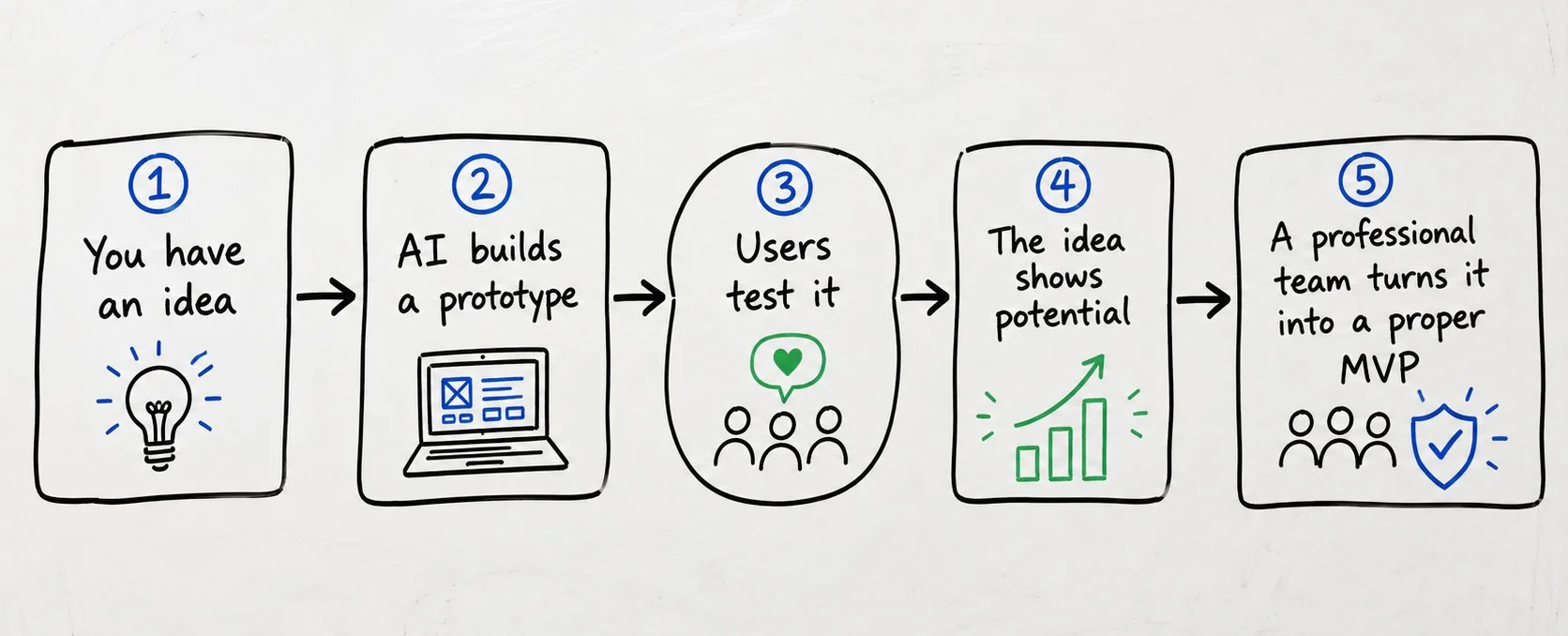
The pipeline now looks roughly like this:
The idea. A founder, PM, or engineer has a hypothesis about a problem worth solving.
The vibe-coded prototype. Instead of writing a spec and routing it through a team, that person builds a working version themselves, often in hours rather than weeks.
The test. The prototype goes in front of real users. Something they can actually use.
The signal. People respond to it, or they don't. This step has never been cheaper.
The handoff. If the signal is good, the prototype moves to the core product development team, whose job is to turn "people want this" into something that can actually be shipped, scaled, and maintained.
The real change is in steps two through four. What used to require a cross-functional team and a sprint cycle now takes one person and a day. That's worth taking seriously, not because vibe coding produces better software, but because it makes bad ideas cheap to disprove and good ideas fast to find.
What this genuinely buys you
Vibe coding is especially effective when the goal is to create a believable version of a straightforward product flow. It works well for landing pages, dashboards, directories, content tools, internal utilities, CRUD applications, and products built around familiar patterns.
AI is also useful for repetitive development tasks. It can quickly generate forms, tables, basic API integrations, placeholder content, onboarding screens, and standard account management features. A few of other benefits:
The cost of being wrong drops. When testing a hypothesis costs a day instead of a quarter, you can afford to test ideas you're not even confident about. That changes what gets tried in the first place.
Users react instead of imagining. A slide deck or wireframe asks someone to picture a product. A working prototype, even rough, lets them respond to one. And that's usually a more honest kind of feedback.
It lowers the floor for who can build. Product managers, designers, and non-technical founders can produce something real without waiting.
It removes a political bottleneck. In a lot of organizations, getting engineering time allocated to an unproven idea is itself a negotiation. Someone who can build a testable version alone skips that step entirely.
This allows the founder to focus on the product hypothesis rather than the technical setup. For example, imagine a startup that wants to help restaurants sell unused food at the end of the day. The riskiest question is not whether developers can build restaurant profiles, product listings, and a checkout flow. The risk is whether restaurants will regularly upload offers and whether customers will change their routines to buy them. A vibe-coded prototype can create a realistic version of the experience quickly enough to test those behaviours before the company invests in a full delivery platform.
These are structural changes to how early validation works, and they're the reason vibe coding has earned its enthusiasm. The problem is that the enthusiasm tends to stop right where the real work starts.
“It makes bad ideas cheap to disprove and good ideas fast to find.”
Where it begins to struggle
AI-generated development becomes less reliable as the product moves away from standard patterns. Complex permissions, unusual business rules, financial transactions, real-time systems, large data volumes, offline functionality, advanced mobile features, and integrations with legacy infrastructure all require more careful engineering.
AI can also produce solutions that appear reasonable but contain hidden security problems. OWASP Foundation specifically warns about risks such as insecure output handling, sensitive information disclosure, excessive agency, and overreliance on AI-generated results. This matters when a prototype starts handling real passwords, payment information, health data, private conversations, business documents, or access to third-party systems.
Founders should be particularly cautious when the application can perform actions on behalf of users. Sending emails, changing database records, making purchases, publishing content, or accessing private files can turn a small mistake into a costly incident.
Some additional points to remember:
The code usually isn't something to build on. AI-generated code optimized for "working demo, fast" tends to skimp on what a real product needs: proper error handling, security practices, an architecture that survives changing requirements. In practice, "handing it off to be polished" is often closer to "handing it off to be rebuilt," with the prototype used as a reference more than a foundation.
Not every product fits this pipeline. A new onboarding flow or a feature's core interaction can often be vibe-coded into something testable. A product that lives on its backend (data infrastructure, anything touching sensitive user information, systems with real regulatory exposure) is a much worse fit. The parts of a system that make those products actually work are exactly the parts a quick prototype represents least honestly.
A polished demo creates false confidence. It’s the most underrated risk. AI tools are good enough that a vibe-coded product can look and feel finished, which makes it easy for a founder or investor to assume more of the hard work is done than actually is. A demo working is not the same thing as a product being buildable at that quality bar, on that architecture, at scale.
None of this makes vibe coding useless. It makes it narrower than "build your startup." It's genuinely good at fast, cheap validation of user-facing hypotheses. Treating the output as a finished asset instead of a disposable proof is where it gets oversold.
“The higher the potential cost of an error, the earlier experienced engineers should become involved.”
The handoff is the part that matters
If there's one place to keep your skepticism sharp, it's the handoff — because it's the step the "one person, one day" story tends to skip entirely.
A few things separate a handoff that goes well from one that doesn't:
Decide upfront whether the prototype is disposable. In most cases, it should be treated that way: a working spec that shows the core team what to build. Not code they're obligated to extend. Incrementally refactoring vibe-coded work into a production system often costs more than rebuilding the relevant parts outright.
Loop in engineering before it's validated. Even a brief technical review during the prototyping phase can catch an approach that won't hold up at scale, before the team gets attached to a direction that later has to be undone.
Treat the prototype as done once it's answered its question. Its job was to test user behavior, not to serve as a beta of the real product. Being clear about that with users, stakeholders, and your team saves a lot of downstream confusion.
Apply real scrutiny to anything touching user data, even at the prototype stage. "It's just a test" isn't a reason to skip basic security hygiene if real users are entering real information.
Summary
The excitement around vibe coding is understandable. For the first time, a non-technical founder can move from an idea to a functional application without assembling an entire product team. That is a meaningful shift.
But speed makes good decisions more important, not less important.
AI can build features that nobody wants faster than any development team in history. It can also create technical debt before the startup has acquired its first real customer.
The companies that benefit most will use AI to test ideas with a clear purpose. They can use AI to run more focused experiments, reject weak ideas earlier, and bring professionals in when the evidence justifies building something durable.
In the past, a startup often had to commit a team before it could properly see the product. Vibe coding allows one person to see the product before the team commits. That is its real role in MVP development. It does not replace the journey from idea to production. It makes the most uncertain part of that journey dramatically faster.
