From Dynamo to Computer, and Further to AI
Every few months somebody says “AI is the new electricity”, usually while trying to sell something, and the comparison is almost always lazy: two enormous technologies gestured at side by side, with nothing said about how the comparison works underneath. There's a sharper version of it, and it comes from a nine-page paper called The Dynamo and the Computer, written in 1990 by an economic historian named Paul David, a paper almost nobody outside economics has read.
David wrote the paper to answer a specific question economists were arguing about in 1990. American businesses had spent the previous two decades pouring money into computers, and measured productivity growth, output per hour of work, had barely moved. Nobel Prize winner Robert Solow summed it up: “We see computers everywhere but in the productivity statistics.”
“We see the computers everywhere but in the productivity statistics.”
David’s argument wasn’t that computers had failed to deliver. They just didn’t have enough time to reshape the economy around them. Businesses were buying computers while keeping organizations and workflows designed for a world without them: typing documents on a computer, printing them out, and filing the paper in a cabinet. The technology was arriving faster than the complementary changes needed to make it productive. “The Dynamo and the Computer: An Historical Perspective on the Modern Productivity Paradox” is the attempt to explain that puzzle. And it does it by telling a story about factories fifty years earlier.
In 1899, fewer than one in twenty machines on an American factory floor ran on electricity, even though the technology had been commercially available for two decades and central power stations were already lighting entire blocks of Manhattan and London. Walk into a typical mill that year and the thing turning the lathe was still a leather belt slung off a long iron shaft bolted across the ceiling, the same arrangement that had powered factories since the age of steam.
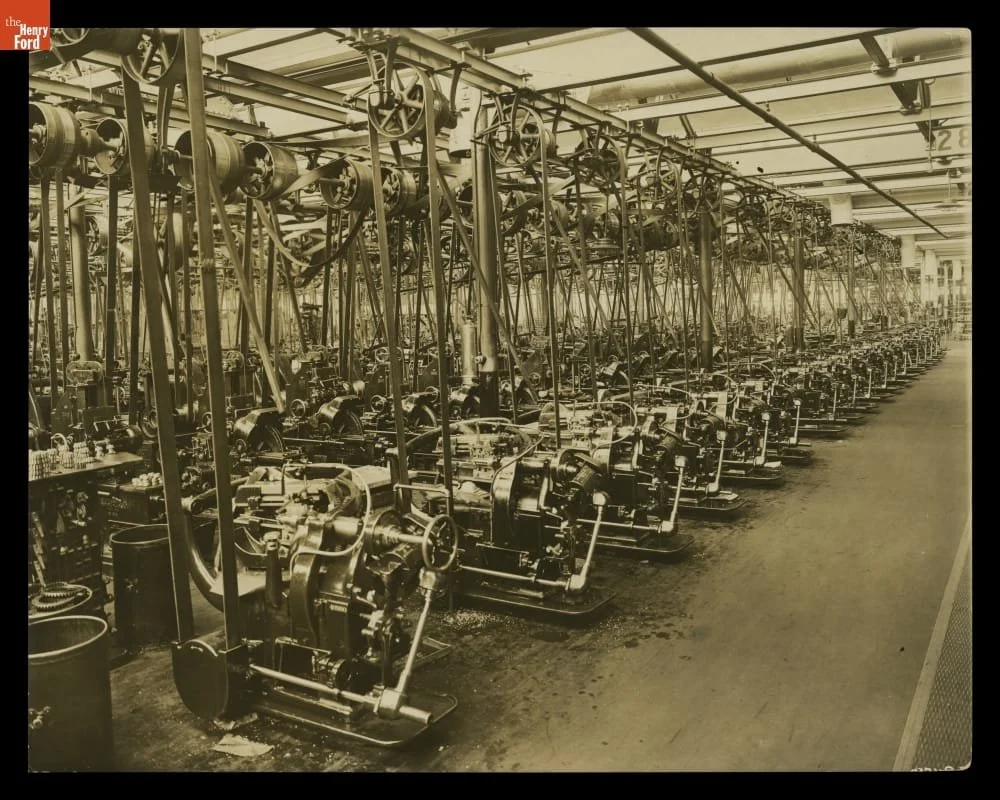
1913. Old shaft-and-belt factory. Ford Highland Park machine shop. The ceiling is covered with shafts, pulleys, and belts connecting machines to a central power system.
Group Drive, Unit Drive
David's answer sat in architecture. Factories kept the machines and changed almost nothing else, bolting a motor where a steam engine used to sit while the floor plan, the shafts, the belts, the whole choreography of how power moved through a building stayed frozen in the previous century. The setup was called group drive: one motor at the top, turning a shaft that ran belts out to a dozen machines. Swapping the engine barely touched anything downstream, saving some coal on the fuel bill but reorganizing nothing about how the factory worked. Worse, the old shafting stayed on the books as capital right alongside the new motor, so the accountants doing the productivity math were stuck counting equipment that no longer needed to exist. Some of these early electrified factories looked, on paper, less efficient than the ones they replaced.
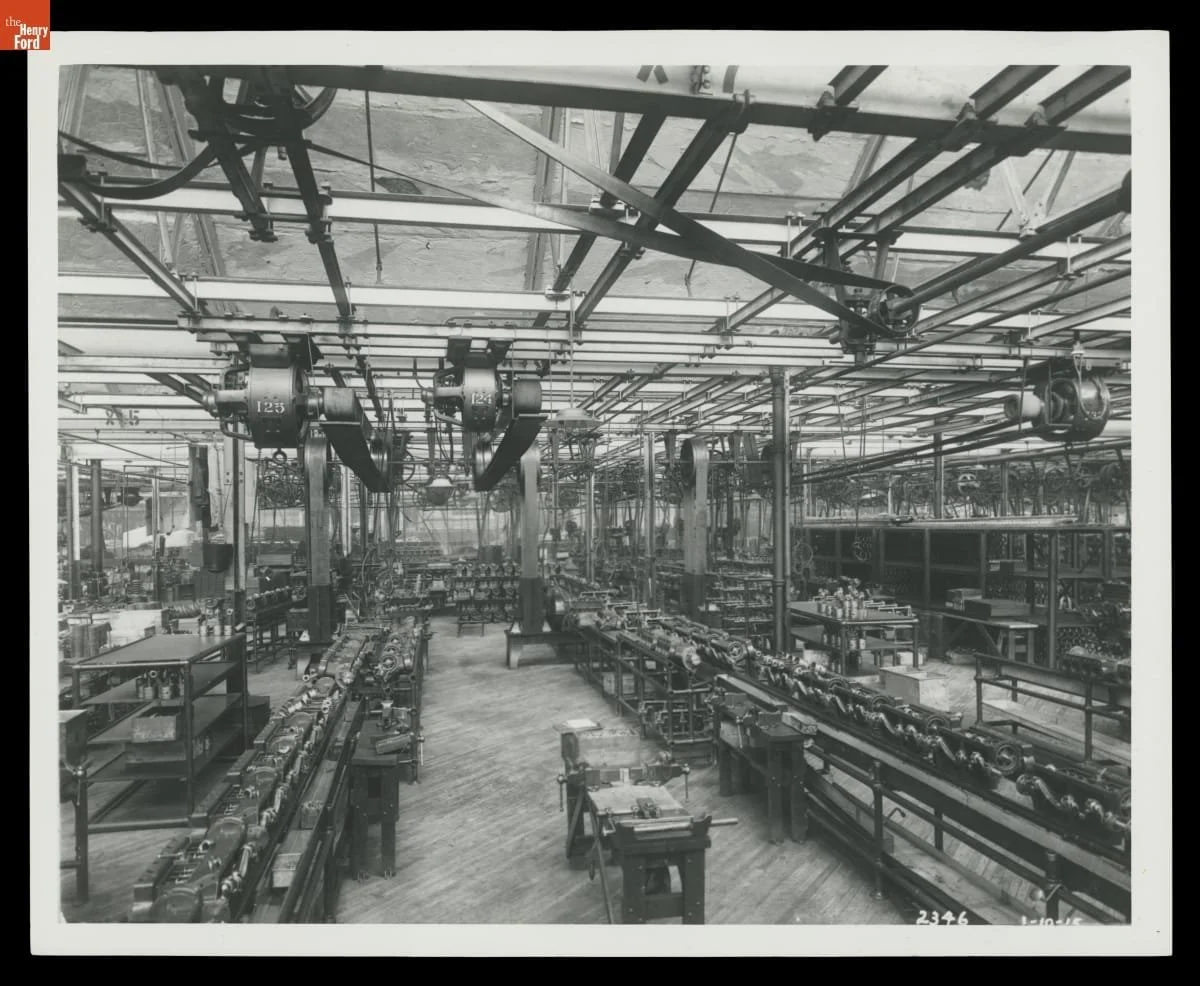
1915. Group drive / awkward transition. Electricity has arrived, but the factory still uses the old shaft-and-belt architecture. Example how companies initially used the new technology inside the old workflow.
Real gains waited for something called unit drive: a small motor on every machine instead of one big one feeding a web of belts. That single change let engineers tear out the shafting entirely, which meant factories no longer needed the heavy overhead bracing built to support it. Buildings got lighter. They dropped from multiple stories, originally built tall just to keep the shaft runs short, down to a single open floor where machines could sit wherever the work flowed best and get moved again next year without touching a wall. None of this happened quickly (~40 years). It took a generation of engineers who'd grown up designing around steam to retire, and a generation raised on electricity to take their place, before factories got designed around the wire from the start.
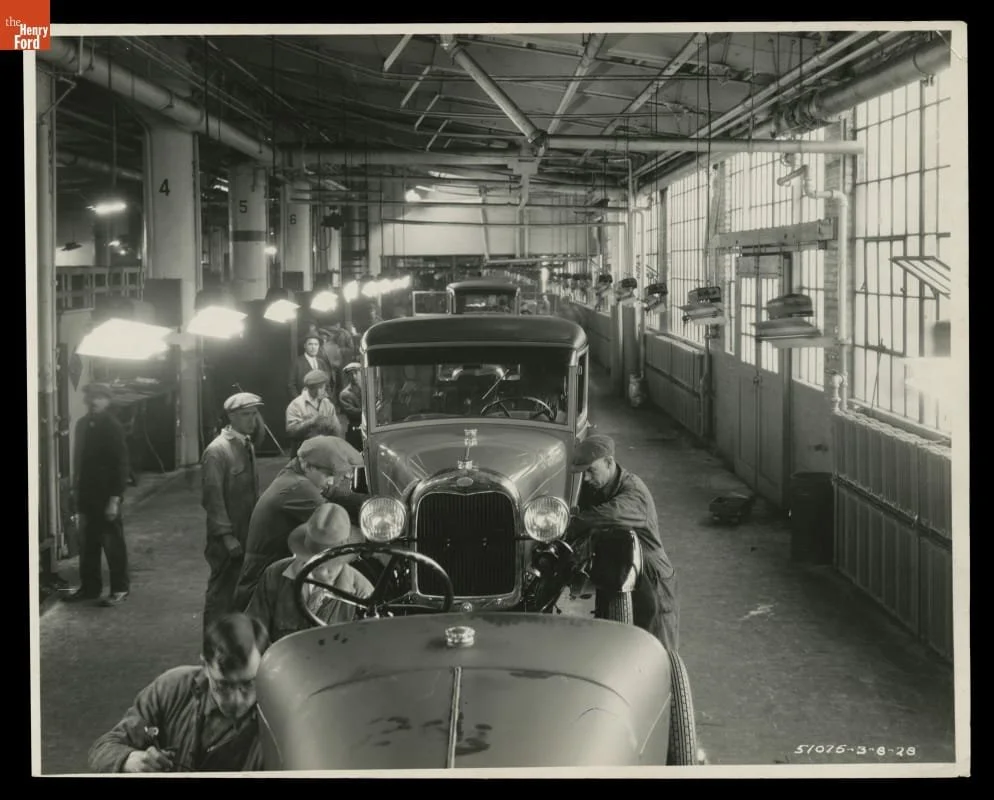
1928. Factory redesigned around electricity. Ford Rouge assembly line. The forest of belts has disappeared. The floor is open and production is organized around workflow rather than power transmission.
The Chatbot in the Corner
Most companies buying AI in 2026 are doing exactly what early factories did with electricity, and what companies later did with computers: putting a new technology inside an old organization. A chatbot gets stapled onto the corner of the CRM, and a copilot starts dropping suggested sentences into the same document a human still opens, edits, and sends through the same approval chain that existed many years before. Meetings still run at the same length with the same ten people invited out of habit, except now something is quietly summarizing them afterward. The org chart hasn't moved, and neither have the job titles printed on business cards many years ago.
This is the distinction that matters. The first phase of AI makes the old workflow faster. The second phase asks why that workflow exists at all. A copilot that drafts an email in 30 seconds instead of ten minutes is “group drive”. The task got cheaper, but everything around it stayed the same: someone still writes the email, someone else reviews it, another person approves it, and eventually someone sends. The “unit drive” version looks different. Maybe there is no email. Maybe there is no handoff, no approval queue, and no person whose job is to move information from one system to another. The agent sees the event, makes the decision within defined limits, updates the systems, and only brings in a human when something falls outside those limits. That is where the electricity analogy becomes useful. The biggest gains didn’t come from making the old factory run faster, but from realizing the factory no longer had to be built that way.
Enterprise data is starting to back this up. A study out of MIT this year tracked manufacturing firms after they adopted AI tools and found productivity dropping in the months right after, before any gain showed up later, the same J-curve you'd expect from bolting new capability onto an old structure and asking the structure to absorb it without changing shape. Separate surveys keep finding the same split: individual workers report measurable time savings on specific tasks, while the company as a whole sees almost none of it reach the bottom line. Nearly six in ten executives say their existing IT systems are too tangled to connect AI agents into the core of the business. That sentence could have been written in 1905 about a steam-powered textile mill.
Now take that logic further: AI sitting at the level of the individual task, granular enough that the task stops needing a fixed human owner at all. A contract doesn't route through a legal team anymore, because a legal team was a batching mechanism, a way to pool expensive expertise across more work than any one lawyer could review alone. Once review gets cheap and close to instant, batching stops paying for itself, and so does the team that existed to do the batching.
The same logic eats through most of what currently gets called middle management. A lot of that layer exists to translate, taking what's happening on the ground and compressing it into a form senior leadership can absorb, then taking decisions from the top and unpacking them back into instructions a team can execute. Doing that well used to require judgment and enough bandwidth to sit in five meetings a week. None of those requirements survive contact with a system that can read everything happening on the ground continuously and write a version of it for any audience on demand. This is also creating a brand new coordination role almost nobody had a title for three years ago: someone whose entire job is making sure a dozen agents are talking to each other correctly.
Here is another cool example: RuntimeWire, an AI newsroom. I came across this example recently and it’s kind of crazy when you put it next to the traditional media model. It’s basically a tech news site run by one guy, Ryan Merket. For example, during Black Hat, a major cybersecurity conference in Las Vegas, OpenAI gave a surprise talk revealing new details about AI agents hacking Hugging Face. Ryan saw a post about the talk, opened the livestream, gave the transcript to AI, and had the story published six minutes later. WIRED had reporters sitting there at the conference, and RuntimeWire still got the story out three hours earlier. Most of the processes run automated. If the AI agent decides a story has low legal risk, it can publish it directly to the news feed. Then other agents translate the story into different languages and turn it into podcasts and videos using synthesized voices. It costs about $100 a day, and suddenly, one person can do the work of an entire newsroom.
“The first phase of AI makes the old workflow faster. The second phase makes you ask why that workflow exists at all.”
Timing
David's factories waited on physical depreciation, because nobody tore down a working mill just to change its wiring, so the unit drive future had to wait for old buildings to wear out and new ones to get built around the new logic on purpose. AI skips that step entirely. Software doesn't rust the way steel does, and a five-person company can spin up a competitor to a thousand-person incumbent without laying a single brick or waiting on anyone's depreciation schedule. The forcing function this time is competition, moving on a timeline measured in product launches instead of decades, fast enough that the redesign either happens inside existing companies within a handful of years, or it happens to them, done from outside by someone who never had an old shaft to protect in the first place.
There's a second parallel here. David spent part of his paper on the fact that early electrification showed up as better light quality and safer workshops, neither of which the productivity statistics of 1910 had any real way to count. That same blind spot applies now, and it's worse. A tool that gives a small business owner in a town with no lawyer something like real legal advice for the price of a subscription doesn't show up anywhere in GDP as a service being produced, because that service never existed at any price a person like that could pay, so there's no prior year to compare against. Free tutoring at the level of a decent private instructor, personalized to one kid, available at two in the morning: that isn't a productivity gain by any measure currently in use, because there was never a market for it to displace.
Here's my bet on timing, and I want to name a year instead of hiding behind vague talk about "the years ahead." The physical bottleneck that stretched the dynamo out to forty years doesn't apply here. Rebuilding an electrified factory meant physically rebuilding, city by city, because nobody can pour identical foundations with the same construction crew in two states on the same day. Redesigning a company around AI has no such constraint. A new way of running a supply chain can move from a whiteboard in Austin to every warehouse a company owns by the following Tuesday, so that part of the delay compresses to almost nothing.
What doesn't compress is the human half. Trusting a system enough to remove the person sitting on top of it as a checkpoint is a generational habit, and it shows up fastest in people who started their careers after agents were already good enough to run a client account without supervision. That cohort is currently in its twenties. It reaches the seniority required to rewrite how a company operates sometime in the mid-2030s. My guess is the AI equivalent of the 1920s, the decade when the productivity numbers finally catch up to what's happening on the ground, lands somewhere around 2035, once the people making resourcing decisions are the ones who grew up trusting these systems instead of the ones who spent a career being warned away from them.
One more thing
There's one more piece of David's argument I think people are skipping past. Some of the biggest productivity gains from electrification in the 1920s came from continuous process manufacturing, in industries like chemical production and oil refining, running on electrical instruments and control loops that nobody at the time thought of as part of "the electricity industry." The dynamo had already disappeared into the walls.
We can make the same prediction for this decade. The category "AI company" is going to dissolve as the technology succeeds completely enough to stop being a special case at all. Right now, a startup can raise money by putting the word “AI” in its pitch deck. In fifteen years, that will sound as strange as a company today describing itself as an "electricity company" for using motors on its factory floor. The technology that wins disappears into infrastructure, the water pressure sitting in the pipes, invisible until the day it isn't there.
Nobody living through 1900 could have told you which factories would still be standing in 1925 and which ones were about to be torn down and rebuilt from the studs up. The people running the leather-belt mills mostly believed they were being efficient, and in a narrow sense they were right, since the motor did save fuel. They just had no way of seeing the shape of a building that hadn't been designed yet. We're roughly in that position now, staring at meetings that still run the old length and approval chains that still have the old number of steps, with no reliable way to tell which of it is load-bearing and which of it is a leather belt somebody forgot to take down.