7 Powers Explained: How Startups Build Moats Competitors Can’t Copy
What happens when a competitor copies everything you are doing?
Building software has never been cheaper. Describe your idea to an AI coding assistant and… a solo founder can ship a working SaaS clone over a weekend. No engineering team, no funding round, no months of runway required. Which means "we built a working product" no longer counts as a strategy. It barely counts as a differentiator. If a stranger with a laptop can rebuild what you shipped, you don't have a moat. You have a head start. And head starts that used to last quarters, now last days.
This is exactly why Hamilton Helmer’s 7 Powers: The Foundations of Business Strategy feels more relevant than ever. Written years before “vibe coding” made software dramatically easier to reproduce, the book explains why some companies stay ahead for decades while others are copied, commoditised, and forgotten.
Seven Powers is one of the most respected frameworks for understanding competitive advantage in the business and investing world. The idea is simple: there are seven ways a business can build an advantage that’s hard to copy, no matter how cheap or fast building becomes. Here is the framework, translated for startup founders.

Power = Benefit + Barrier
To build a valuable company, you need more than growth. You need what Helmer calls Power: a structural advantage that allows your company to produce better results than competitors for a long time. Power let a company earn persistently higher returns than everyone else in its market. That only happens when two things are true at once:
Benefit: the advantage actually improves cash flow (higher prices, lower costs, or less capital required).
Barrier: something stops competitors from copying it or competing it away.
And here's the twist: Benefit is common. Almost any decent idea creates one. Barrier is rare. Helmer's advice — check the Barrier first, because that's the part that's genuinely hard to build, and the part your competitors are betting you don't have.
“Power is the answer to this question:
Why can’t another company simply do what we do?”
The 7 Powers
1. Scale Economies
Costs drop as you grow, so a rival can't match your unit economics without first matching your size. Getting bigger makes your business cheaper or more efficient to operate.
Imagine two delivery startups. The first completes 100 deliveries in a city. The second completes 100,000. The larger company can spread its software, support, marketing, warehouses, data systems and management costs across far more orders. It may also have more drivers nearby, reducing delivery times and costs. The larger company is not simply bigger. Its size makes it structurally stronger. That is Scale Economies.
For software startups, this can come from expensive infrastructure, compliance, research or engineering work that becomes cheaper per customer as the customer base grows.
But founders should be careful. Growth alone is not a Scale Economy. If every new customer requires another employee, more support and roughly the same cost to serve, you may have scale, but not scale power.
Ask yourself: Does each new customer make the economics of serving the next customer better?
2. Network Economies
Network Economies exist when each new user makes the product more valuable to other users.
Airbnb is the obvious example. More hosts create more choice for guests. More guests attract more hosts. The two sides strengthen each other. The same pattern appears in marketplaces, social networks, communication products and collaborative software.
However, founders often claim network effects far too early. Having users does not automatically create a network effect. A meditation app with one million users may not become meaningfully better when user number 1,000,001 joins. A marketplace, by contrast, may become more useful because that extra participant improves selection, availability or liquidity.
Ask yourself: Does adding another user create measurable value for existing users? If not, you may have distribution. You do not yet have a network economy.
3. Counter-Positioning
Counter-Positioning is the most startup-friendly of the seven powers. It happens when a newcomer introduces a business model that incumbents struggle to copy because copying it would damage their existing business.
Netflix is the classic example. Blockbuster made money from physical stores and late fees. Netflix introduced a subscription model without the same penalties or store network. Blockbuster could see what Netflix was doing. But the problem was not a lack of intelligence. The problem was that fully copying Netflix meant undermining the economics of its own business.
This is why Counter-Positioning can be so powerful. The incumbent appears slow, confused or arrogant, but it may actually be trapped. Many startups describe themselves as “disruptive” when they are simply offering a prettier interface or a lower price. Real Counter-Positioning is more painful than that. Your model should force the incumbent to choose between ignoring you and damaging itself.
Ask yourself: What profitable part of an incumbent’s business would it have to sacrifice to copy us? If the answer is “nothing,” the incumbent may copy you more quickly than expected.
4. Switching Costs
Switching costs are the pain customers experience when they replace your product. This pain can come from migrating data, retraining employees, rebuilding integrations, changing workflows, risking downtime or explaining the decision to management. That is why deeply integrated B2B products can become difficult to remove.
A restaurant may begin using a platform for payments. Later, it adds staff management, inventory, customer loyalty, reporting and online ordering. Eventually, replacing the platform is no longer a simple software decision. It feels like performing surgery on the business while the business is still running.
Founders sometimes confuse customer satisfaction with Switching Costs. A customer can love your product and still leave tomorrow. Real Switching Costs appear when leaving creates measurable financial, operational or emotional pain. Of course, the goal should not be to trap customers with bad contracts or deliberately obscure data exports. The strongest Switching Costs usually come from genuine value: accumulated history, connected workflows, collaboration and customisation.
Ask yourself: What would break if the customer removed our product next week? If the answer is “not much,” your Switching Costs are probably weak.
5. Branding
Branding is one of the most misunderstood powers. It is NOT having a modern logo or posting memes from the corporate account.
Branding becomes Power when customers are willing to pay more (or choose you more quickly) because of the reputation associated with your company.
Liquid Death sells water in cans using the visual language of heavy metal and energy drinks. The product is simple. The brand changes how people perceive it, talk about it and value it.
The same principle applies in technology. A strong brand can reduce customer hesitation. It can signal quality, safety, status or reliability. In markets where buyers cannot easily evaluate every technical detail, trust becomes extremely valuable. Apple is a great example. Customers often pay a premium for an iPhone or MacBook even when competing products offer similar features for less. They are not buying specifications alone. They are buying “Apple philosophy” with design, status, privacy, and simplicity. That reputation reduces hesitation and makes price comparisons less important.
Remember, brand power takes time. You cannot declare that you have a premium brand because you increased your prices. Customers must demonstrate that they believe it.
Ask yourself: Would customers still choose us if a competitor offered similar features for less? If not, your brand may be attractive, but not yet powerful.
6. Cornered Resource
A Cornered Resource is a valuable asset that competitors cannot easily obtain. It might be exclusive technology, a patent, a regulatory approval, a unique dataset, a scarce location, a distribution agreement or access to exceptional talent.
Rocket Lab’s private launch facilities are a physical example. Biotech companies build their advantage around patents, licences and regulatory approvals.
For software founders, the fashionable answer is usually “our data.” Sometimes that is true. More often, the data is small, publicly available, easy to reproduce or not particularly valuable. A resource becomes Power only when it creates meaningful business value and competitors cannot easily acquire an equivalent.
Even having a brilliant technical co-founder is not automatically a Cornered Resource. Talented people can leave. Competitors can hire other talented people. The resource must be both valuable and difficult to reproduce.
Ask yourself: What do we control that a well-funded competitor could not simply buy, build or hire? If everything can be reproduced within months, the resource is not truly cornered.
7. Process Power
Process Power is the rarest and perhaps most mysterious of the seven. It appears when a company develops an internal way of operating that produces exceptional results, and competitors struggle to replicate it.
Toyota is the textbook case. Toyota Production System has become a benchmark in the automotive industry and beyond, known for its principles like Just-In-Time production and Kaizen. Competitors have toured its factories for decades and still can't fully replicate what they saw. Because it's a culture, not a manual.
Amazon’s “Working Backwards” approach is a familiar example. Teams begin by defining the intended customer experience and work backwards toward the product.
The individual steps can be explained. A competitor can read about them. It can download templates and introduce similar meetings. But copying the visible process is not the same as copying the organisational habits, judgment, hiring standards, incentives and culture built around it. That is what makes Process Power difficult to reproduce.
It usually takes years to develop because it depends on accumulated learning. The process becomes embedded in the organisation rather than stored in a Notion document nobody opens.
Process Power exists when the organisation repeatedly produces better outcomes because of how the entire system works.
Ask yourself: Could a competitor reproduce our results by hiring a few employees and copying our playbook? If yes, you have a process. You probably do not have Process Power yet.
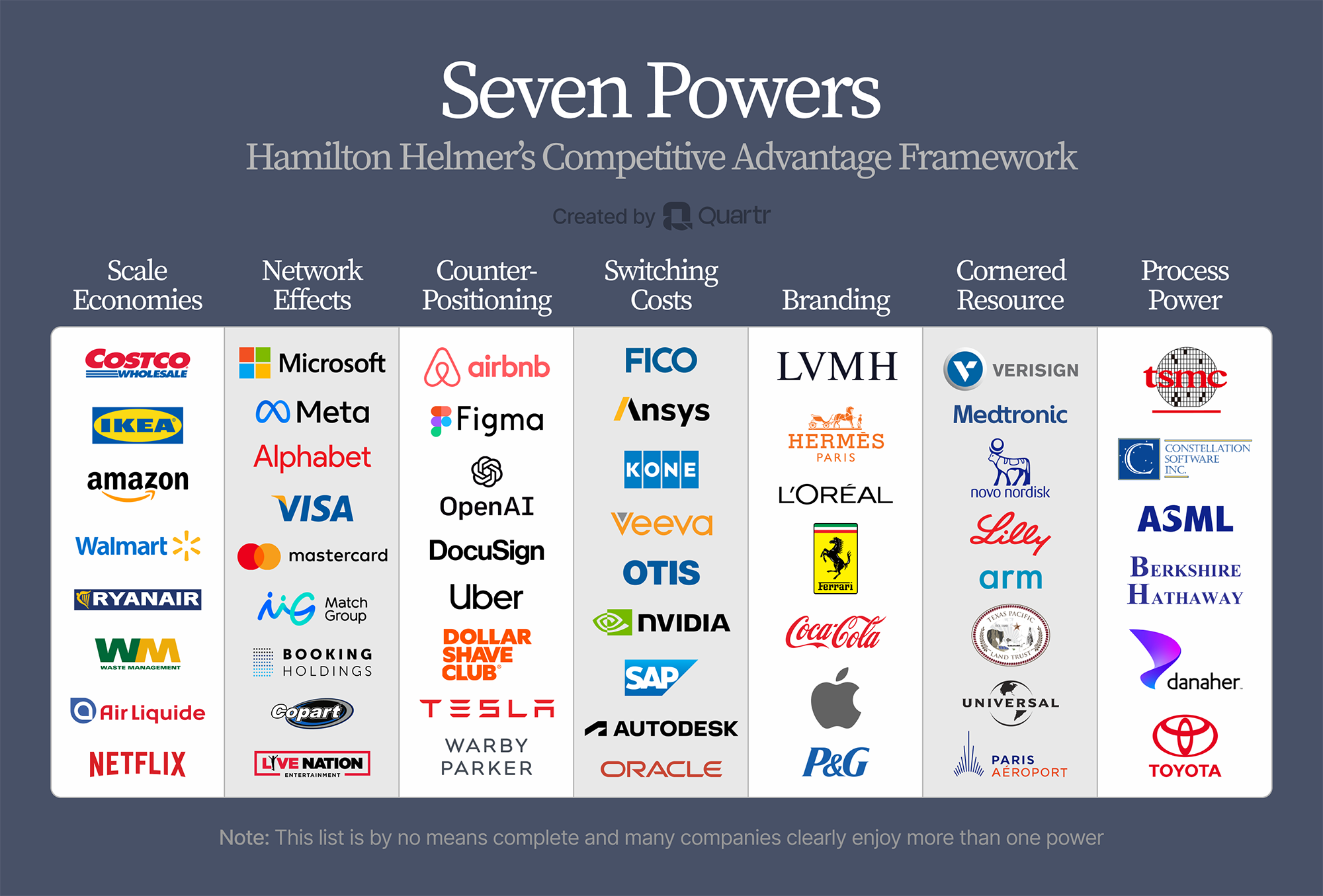
Famous examples by Quartr
You Don’t Need All Seven
Reading the list can make founders feel that they need to create seven moats before launching an MVP. They do not. Most great businesses begin with one potential source of Power and add others as they grow.
A startup may begin with Counter-Positioning by introducing a model incumbents dislike. Growth may then produce Scale Economies. Product adoption may create Switching Costs. A marketplace may eventually develop Network Economies. Brand and Process Power often arrive much later because they require time and consistency.
The important point is not to manufacture a moat before finding product–market fit. It is to notice which Power your business could realistically develop, and make decisions that strengthen it.
A marketplace founder should obsess over liquidity, not vanity user numbers. A B2B SaaS founder should think about workflows, integrations and accumulated customer value. A consumer founder pursuing Branding should measure willingness to pay, direct traffic and customer preference (not merely social media impressions).
Timing matters more than the list itself
This is the part part that actually matters for founders. Helmer argues these seven powers aren't all available to you at once. He maps a "Power Progression" across three stages of a company's life:
Origination (the idea stage): lean on Counter-Positioning and Cornered Resource. You're small, so you need an asymmetry, not an army.
Take-off (the growth stage): Scale Economies, Network Economies, and Switching Costs start compounding as you pick up users, data, and integrations.
Stability (the mature stage): Branding and Process Power take over, both built on years you haven't earned yet as a startup.
The practical takeaway: don't chase a "brand moat" before launch, and don't panic that you lack scale economies before you've shipped. Each power has its season. The job is knowing which one you're actually building toward.
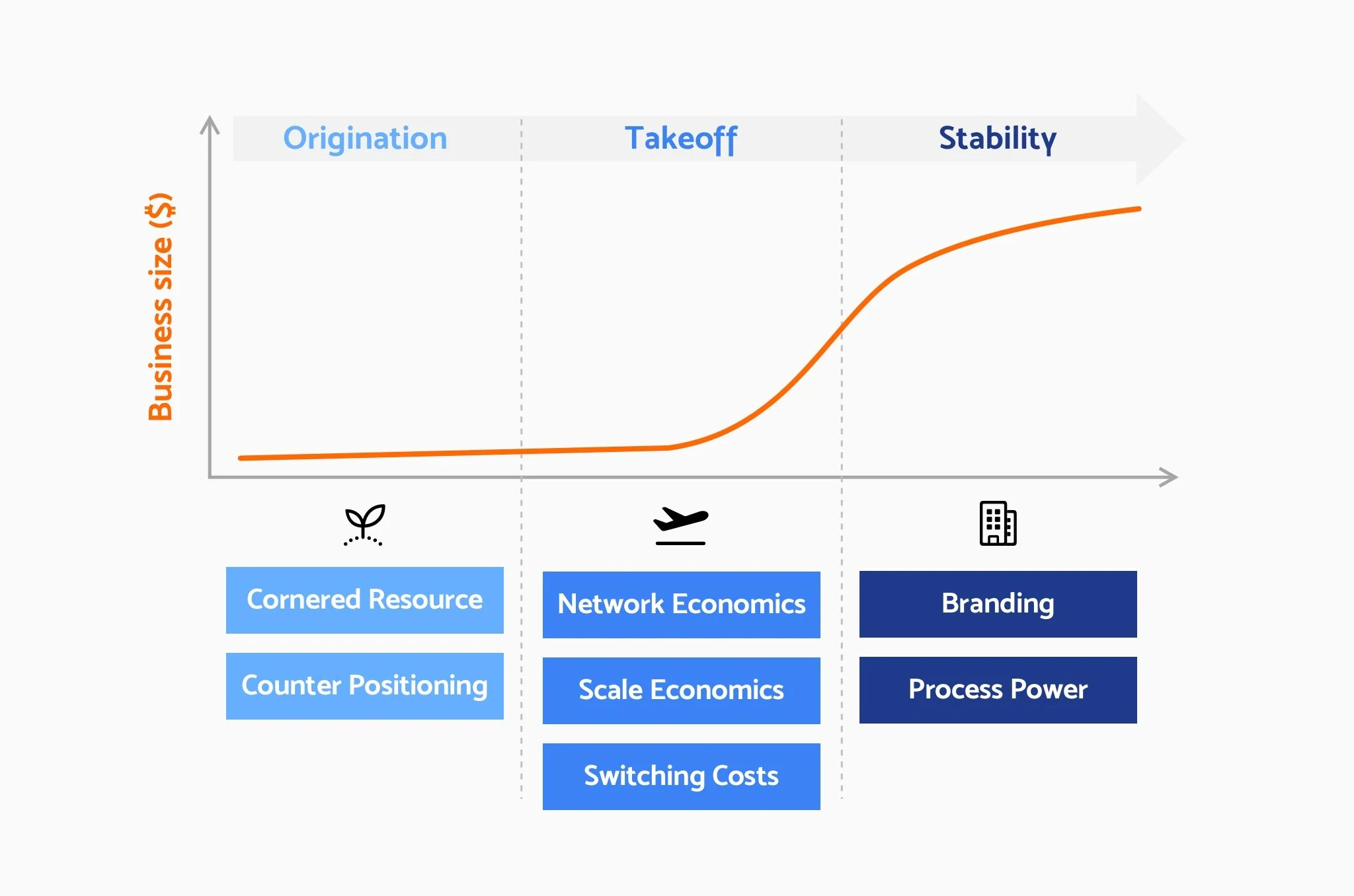
Power Progression
Why it's worth the weekend
Most strategy books leave you inspired and empty-handed. 7 Powers leaves you with a question you can run on your own company right now: do I have a real Benefit? Is there an actual Barrier? Which of the seven, if any, is protecting it?
In the AI era, almost everything can be copied faster than ever: features, interfaces, content, pricing and even entire products. That makes building real Power more important than ever. The companies that survive will be the ones that create advantages competitors cannot reproduce with better prompts, more funding or a faster development team. Because when building becomes easy, the moat becomes the business.